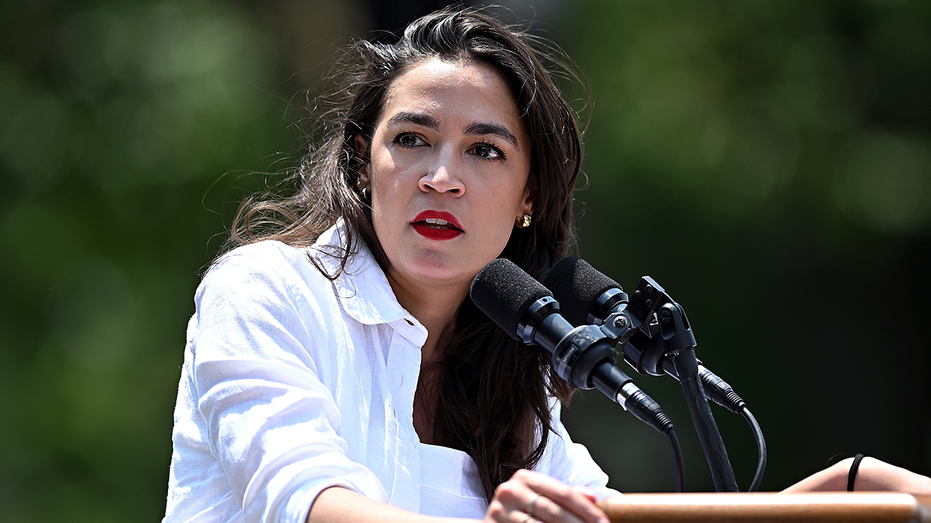
The Democratic Socialists of America (DSA) is facing infighting over the selection of its presidential pick, as the group's influence grows on the national stage and speculation swirls about a 2028 presidential run by Rep. Alexandria Ocasio-Cortez, D-N.Y.
The division within the group, which has emerged as the preeminent socialist group in America, reveals fractures among its roughly 120,000-member base. The infighting also sheds light on how some DSA members believe the group can gain a permanent foothold in American politics and deliver on its socialist ideals on a national scale.
Some DSA leaders have been pushing for an earlier presidential endorsement, in place of the group's normal practice of selecting endorsements at its biennial national convention, which is set for summer 2027. One faction, known as the "Groundwork" caucus, is advocating for a national member poll to endorse AOC on day one.
The caucus believes an early endorsement will help DSA hold a more influential early role in 2028 presidential politics and "build power for socialism." However, in a Sunday 14–13 vote, DSA's National Political Committee (NPC) rejected a proposal to allow the group's 2028 presidential endorsement to be decided through a nationwide all-member poll.
The decision was met with criticism from many DSA members, who took to social media to express their disappointment. Gustavo Gordillo, co-chair of the group's New York City chapter, posted that DSA's national leadership had "taken away rank and file members' right to vote" in an all-member poll on presidential endorsement.
Gordillo also noted that the group's largest chapter, NYC-DSA, sends the national committee ~ $2M per year in dues. J. Ryder, a founding editor of a magazine on communism, wrote that the committee's decision to suppress polling the will of the members on presidential endorsement is "severely disappointing."
Ryder added that the decision will inevitably put DSA on the back foot in the 2028 moment, saying "Waiting to endorse in August of next year at the convention may mean 6 months+ of vital AOC campaign time where the masses will be mobilizing without intervention by DSA."
In response to criticism, committee member Amy Wilhelm fired back at Gordillo, saying that "NYC members deserve co-chairs that don't lie." Wilhelm stated that there was never an intention to prevent DSA members from participating in chapter polls, and that chapters are allowed to carry out polls per their standard method.
Eve Seitchik, a Massachusetts DSA member, characterized the events of the day as "a massive escalation of factional tensions," adding "I'm afraid DSA has been set down a dangerous path." The infighting within DSA has raised concerns about the group's ability to position itself as a viable force in 2028 presidential politics.
DSA's recent electoral wins and Ocasio-Cortez and Sen. Bernie Sanders' "Fight Oligarchy" tour have shown that there is energy across the country to support a bold, democratic socialist presidential campaign. However, the group's decision to reject a national member poll has left many wondering whether DSA will be able to capitalize on this momentum.
Rumors are circulating about Ocasio-Cortez's potential presidential run in 2028, with some speculating that she may opt to run for the Senate instead. The four-term congresswoman has not directly said whether she will launch a presidential run, but her influence within the DSA and her advocacy for socialist ideals have made her a key player in the group's deliberations.