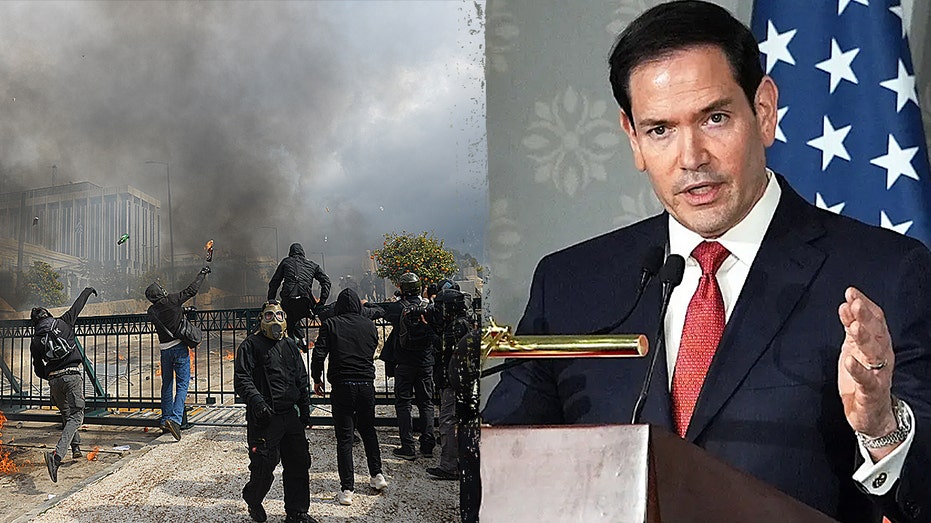
Secretary of State Marco Rubio declared Thursday that violent far-left political terrorism "can no longer be denied" and urged more than 60 countries to treat the threat as a global counterterrorism priority.
Speaking at the opening of a State Department ministerial attended by roughly 65 foreign delegations, Rubio said governments had spent too long overlooking a resurgence of transnational far-left extremist violence.
He described radical leftism as "a poisonous resentment cloaked in the language of equality and justice" and warned that the share of left-wing terrorist attacks and plots in the United States has risen to levels not seen in decades.
Rubio said the administration is rebuilding U.S. counterterrorism strategy around an increasingly transnational threat, with additional foreign terrorist organization designations forthcoming after four far-left groups were designated in November 2025.
He argued far-left extremist networks coordinate across borders by sharing training materials, encrypted communications, financing, and safe houses while working alongside hostile foreign states.
The secretary called for expanded intelligence sharing, law enforcement cooperation, and efforts to disrupt terrorist financing among the United States and its allies.
A foreign terrorist organization designation criminalizes material support to a group, enables asset freezes under U.S. jurisdiction, and blocks members from entering the United States.
Administration officials said the ministerial culminates an eight-month diplomatic effort to convince foreign governments that violent far-left networks pose a growing cross-border threat requiring coordination.
Some analysts and foreign officials have questioned whether violent far-left groups constitute a cohesive international threat comparable to Islamist extremist organizations.
Others have raised concerns that governments could use such initiatives to target political opponents under the banner of counterterrorism.
Administration officials rejected those concerns, arguing the effort focuses narrowly on criminal and terrorist violence rather than political beliefs.
A senior State Department official said the United States has not sought to disambiguate beliefs and ideologies, noting that in America "you can believe anything you want" until a legal threshold is crossed.
Officials argued governments spent much of the past two decades concentrating on jihadist terrorism while underestimating a resurgence of border-crossing far-left violence.
The official described the trend as a blind spot for partners who have not seen such activity since the 1970s, citing allied reports of rising assassinations and assassination plots.
Administration officials pointed to recent European attacks underscoring the need for cooperation, including July 1 firebomb attacks on homes of Greece's governing party members in Thessaloniki that killed one and injured four.
In January, an arson attack on a Berlin power transmission facility cut electricity to tens of thousands and prompted a federal terrorism investigation.
The meeting builds on actions since late 2025, including the designation of four foreign far-left organizations and a reward of up to $10 million for disrupting their financial networks.
Rubio is expected to argue the groups operate across borders, share tactics, coordinate attacks, and exploit conflicts to recruit, making government cooperation essential.
Treasury and White House officials are also expected to address the ministerial, which will cover threat landscape, terrorist financing, intelligence sharing, and critical infrastructure protection.
Officials said several governments approached the United States seeking to join after recognizing similar domestic trends, reflecting broadening international interest.
The four designated groups — operating in Germany, Italy, and Greece — were cited as having coordinated violent attacks across national borders.