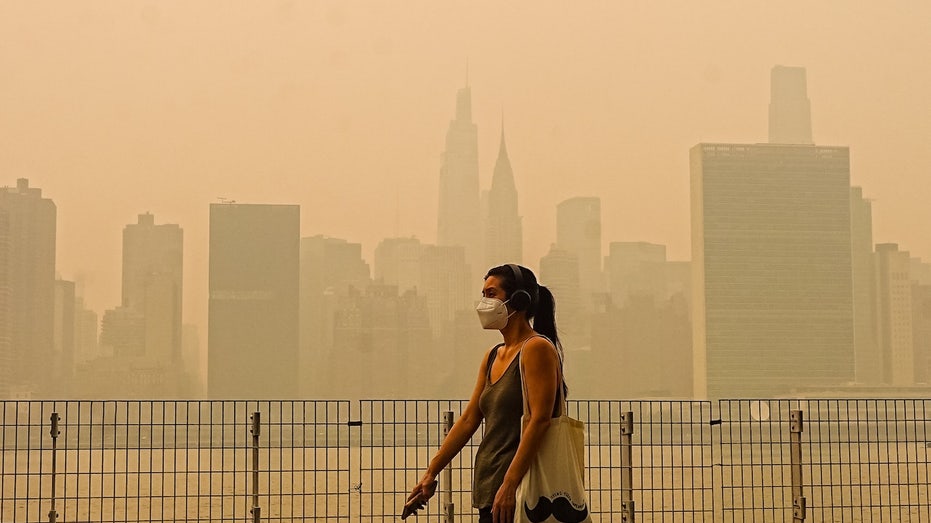
Wildfire smoke originating in Canada has drifted across parts of the United States, prompting health officials to warn that even healthy individuals may face risks from prolonged exposure to polluted air.
More than 180 fires are burning in Ontario and nearly 850 active across Canada, sending smoke into the Midwest and Northeast. The resulting haze has affected over 20 states, triggering widespread air quality alerts from the Upper Midwest to the East Coast.
The primary concern is fine particulate matter, known as PM2.5. These microscopic particles are about 30 times smaller than a human hair, allowing them to penetrate deep into the lungs and even enter the bloodstream.
Symptoms of smoke exposure range from burning or watery eyes, scratchy throat, runny nose, and coughing to chest tightness, shortness of breath, wheezing, headaches, fatigue, and a faster heartbeat. Individuals with asthma, chronic obstructive pulmonary disease, or chronic bronchitis may experience flare‑ups or worsening of existing symptoms.
Smoke can also strain the cardiovascular system, contributing to increased emergency visits for heart disease, irregular rhythm, heart failure, pulmonary embolism, and stroke. Short‑term exposure can worsen heart failure and raise the risk of premature death, while long‑term exposure has been linked to chronic heart and lung disease, lung cancer, cognitive decline, and pregnancy complications.
Children are especially vulnerable because their lungs are still developing and they breathe more air relative to body size. Older adults, pregnant women, and people with heart or lung conditions, as well as those with compromised immune systems or chronic kidney failure, are also at heightened risk. Outdoor workers face exposure simply by spending time outside, and smoke can be invisible when no fires are seen.
Protective measures include monitoring air quality and limiting outdoor activity when the air quality index exceeds 100 for sensitive groups and 150 for everyone. Staying indoors with windows and doors closed, using HVAC systems on recirculate mode, and running a HEPA‑filtered air purifier can reduce indoor pollution. Avoiding activities that worsen indoor air quality—such as burning candles, smoking, frying food, or vacuuming—further helps protect health.
When outdoor exposure is unavoidable, wearing a well‑fitting respirator can filter most harmful fine particles. Reducing strenuous activity and moving workouts indoors until air quality improves are also recommended. Seek medical care if breathing becomes difficult, cough persists, wheezing, chest tightness, dizziness, or heart palpitations occur. Follow any prescribed action plan for asthma or chronic obstructive pulmonary disease, and call emergency services if severe breathing difficulty, chest pain, or confusion arise.
Firefighters and others working directly in high‑concentration smoke zones require comprehensive protective equipment. While the general population is unlikely to experience such extreme exposure, acute health problems can still occur during periods of heavy smoke.