
A recent analysis highlights the growing interdependence of artificial intelligence and the Internet of Things, emphasizing that connectivity must evolve to support increasingly complex, data‑driven applications.
Security is positioned as a foundational element, with a “secure‑by‑design” strategy that integrates protection across devices, networks, and cloud services rather than treating it as an afterthought.
Regulatory pressures are intensifying, expanding beyond traditional device certification to encompass stringent requirements for data sovereignty, AI governance, and overall security compliance.
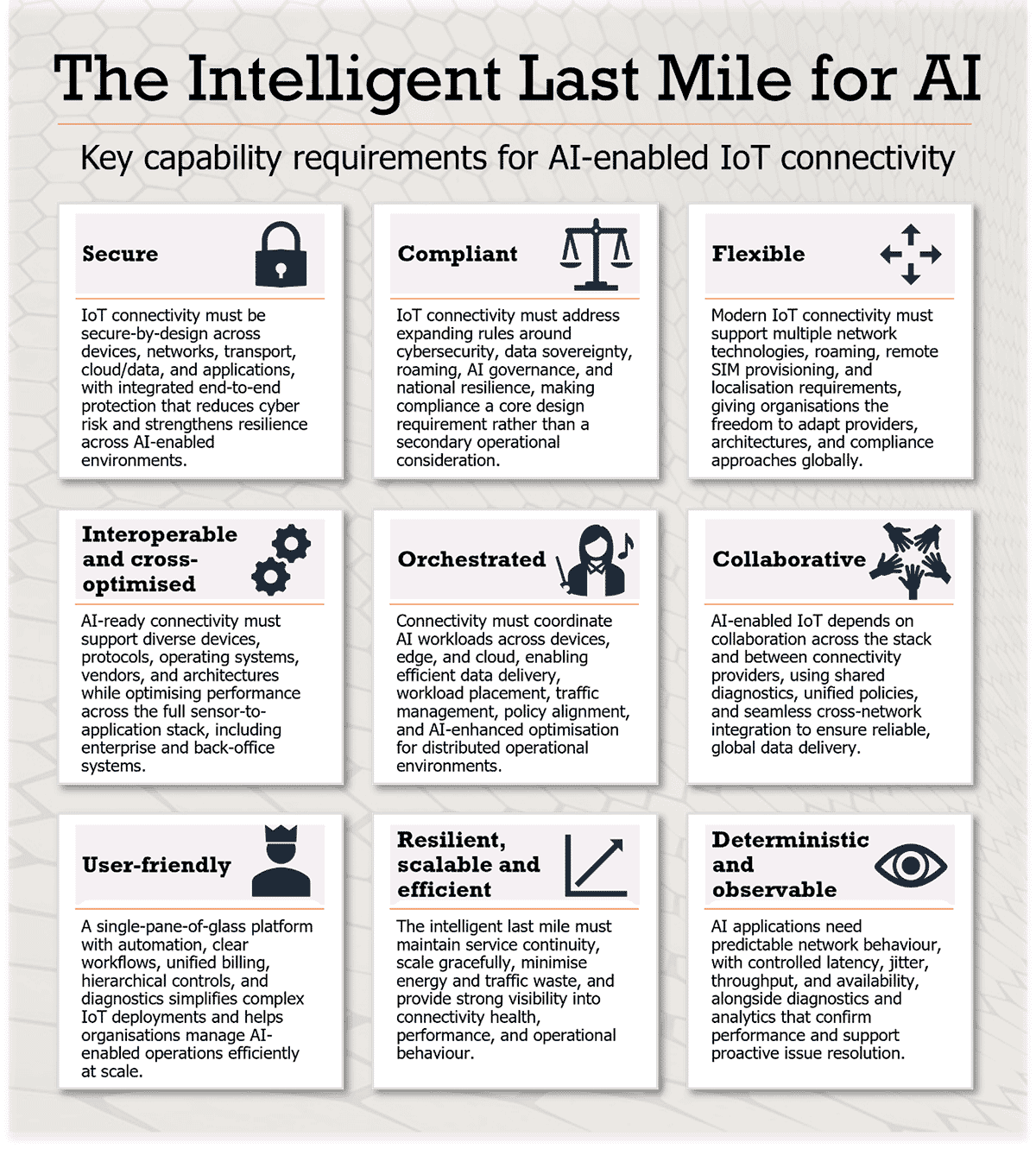
Advances in cellular technologies—including narrowband IoT, LTE‑M, and standalone 5G—combined with remote SIM provisioning, provide a flexible toolkit that can be tailored to diverse deployment scenarios.
Interoperability demands that a heterogeneous fleet of devices, vendors, and networks operate seamlessly, supported by capabilities such as eSIM management and cross‑optimisation of power, processing, and AI model handling from sensor to cloud.
Effective orchestration of AI workloads requires a connectivity layer that can distribute computation between edge nodes for low‑latency inference and central data centres for large‑scale training and aggregation.
Collaboration across the entire IoT stack is essential, with shared diagnostics, open APIs, and unified policy frameworks enabling coordinated behavior and consistent data flow.
User‑friendly management is achieved through a single‑pane‑of‑glass interface that consolidates device control, connectivity settings, policy enforcement, and AI data pathways, reducing configuration errors and simplifying billing and support.
Resilience, scalability, and efficiency are critical as networks must tolerate disruptions, variable signal quality, and hardware faults while scaling to accommodate expanding device fleets and richer AI data streams.
Deterministic performance, characterised by tight control of latency, jitter, throughput, and availability, is reinforced by prioritized traffic classes and deterministic scheduling to meet real‑time inference and actuation needs.
The report concludes with a practical illustration of these principles applied to connected vehicles, demonstrating how an intelligent last‑mile architecture can deliver secure, compliant, and high‑performance connectivity for emerging mobility solutions.