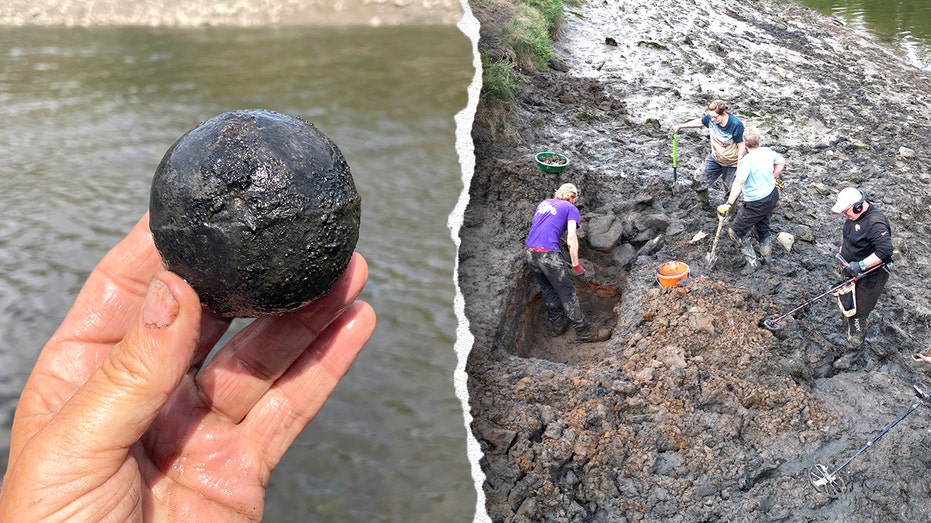
A remarkable discovery in northern England is rewriting the story of Roman Britain. Archaeologists have unearthed a sprawling industrial complex along the River Wear, near Sunderland, revealing a level of sophisticated manufacturing previously unknown in the region.
The excavation, led by Durham University, yielded a stunning find: over 800 whetstones. These weren’t simply tools; they were the lifeblood of Roman industry, essential for keeping everything from weapons to cooking knives razor sharp. This is the largest collection of whetstones from this period ever found in Northwest Europe.
Dating back to between 42 and 238 A.D., the site’s age was confirmed through meticulous sediment analysis. The sheer volume of whetstones suggests a major production hub, churning out tools not just for local use, but for distribution across Roman Britain.
The whetstones weren’t pristine finished products. Instead, the vast majority were discarded rejects – stones that cracked during shaping, contained flaws, or failed to meet the Romans’ exacting standards. Each stone was expected to be uniform, durable, and precisely one Roman foot in length.
This pattern of deliberate disposal, directly into the river, paints a vivid picture of daily industrial life. Waste wasn’t hidden; it was routinely tipped into the water alongside the flakes and fragments created during the manufacturing process. It’s a raw, unfiltered glimpse into the realities of Roman production.
Beyond the whetstones, eleven stone anchors were also recovered, hinting at a thriving river transport network. The River Wear wasn’t just a boundary; it was a crucial artery for trade and the movement of goods.
The significance of this discovery extends far beyond the artifacts themselves. It challenges the long-held belief that the Romans never established a significant presence this far up the River Wear. The academic consensus has been overturned.
Archaeologist Gary Bankhead emphasizes the fundamental importance of whetstones to Roman society. They weren’t specialized tools; they were integral to every craft, from metalworking and carpentry to agriculture and even preparing food. Without them, Roman life would have ground to a halt.
The site also revealed later artifacts, including iron and stone cannonballs and lead shot from the English Civil War, demonstrating centuries of continued activity. But it’s the Roman layer that holds the greatest promise.
Researchers believe hundreds, perhaps thousands, of additional whetstones remain buried beneath the riverbank, waiting to be unearthed. Future excavations are planned, fueled by the site’s enormous research potential.
This discovery isn’t just adding a chapter to the history of Sunderland; it’s fundamentally reshaping our understanding of Roman Britain, proving that its story is far from complete. The River Wear has yielded a secret, and it’s a secret that promises to unlock even more.