
The lifeblood of the Philippine economy – billions of pesos worth of goods – flows through its thousands of ports daily, sustaining markets and the livelihoods of millions. But beneath this legitimate trade exists a hidden current: a sophisticated network of smugglers exploiting loopholes and undermining the nation’s economic stability.
Illicit goods slip into the country concealed within mislabeled containers, landing at unofficial ports, or passing through inspections with falsified paperwork. Sometimes, the passage is secured through more insidious means – the complicity of those sworn to protect the borders. The Bureau of Customs (BoC) stands as the primary defense against this shadow economy, tasked with facilitating legitimate trade, securing borders, and ensuring lawful revenue collection.
Recognizing the scale of the challenge, the BoC has embarked on a sweeping reform agenda, a response to being identified as an area vulnerable to corruption. This initiative, developed in collaboration with the American Chamber of Commerce and the US Embassy, aims to dismantle the structures that enable smuggling and restore public trust.
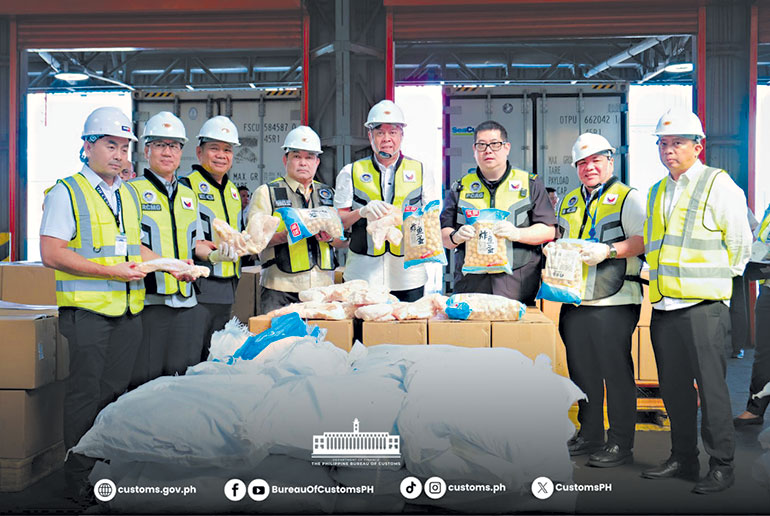
Recent successes demonstrate a shift in momentum. In September, a meticulous inspection at the Manila International Container Port uncovered two 40-foot containers filled with misdeclared frozen chicken and fish balls originating from China. This was not an isolated incident, but a signal of heightened vigilance.
A key component of the BoC’s strategy is accelerating digitalization. A proposed Public-Private Partnership aims to streamline import taxation, potentially implementing a flat fee per transaction, regardless of volume. This modernization effort promises to reduce opportunities for manipulation and increase transparency.
The BoC isn’t fighting this battle alone. Strategic partnerships with organizations like the Land Transportation Office (LTO) are creating a more efficient system for tracking vehicle imports, a sector particularly vulnerable to smuggling. This collaboration ensures a seamless exchange of data, streamlining processes and identifying fraudulent activities.

Joint operations with the Philippine National Police have yielded significant results, confiscating billions of pesos worth of smuggled cigarettes and other prohibited goods. These coordinated efforts demonstrate a unified front against illicit trade, sending a clear message to those involved.
Collaboration extends to the private sector as well. The BoC and the Philippine Iron and Steel Institute (PISI) are building a centralized database to track steel imports, improving classification and valuation. This initiative leverages data analytics and artificial intelligence to enhance stakeholder accreditation and combat underreporting.
The Federation of Filipino-Chinese Chambers of Commerce and Industry, Inc. (FCCCII) has publicly voiced its support for the BoC’s reforms, recognizing the importance of integrity in governance and a competitive business environment. This endorsement from a key economic stakeholder underscores the positive impact of the agency’s efforts.
These improvements are already translating into tangible results. The BoC exceeded its January revenue target, collecting P80.744 billion – a 100.6% collection efficiency and a 1.9% increase year-over-year. This financial success is coupled with aggressive nationwide operations targeting large-scale smuggling.
January alone saw 66 successful operations, resulting in the seizure of P886.8 million worth of smuggled goods. Among the most significant finds were over P309 million in illegal drugs, cleverly concealed within shipments falsely declared as stones, and P209 million in illicit cigarettes, including the discovery of an illegal manufacturing facility.
In Bataan, authorities seized over P105 million worth of smuggled cigarettes, while a raid in Pampanga shut down another illegal cigarette factory. These actions directly address President Marcos Jr.’s directive to dismantle illicit trade networks and safeguard government revenues.
The BoC’s Intellectual Property Rights Division also scored a major victory, seizing counterfeit apparel valued at P428 million at the Port of Manila. Simultaneously, an internal investigation was launched, demonstrating a commitment to accountability within the agency itself.
These combined efforts – policy changes, technological advancements, and strengthened interagency cooperation – are not merely statistics. They represent a measurable shift in the fight against smuggling, protecting the Philippine economy, and rebuilding public trust in the integrity of its borders.


