A silent drama unfolded during Tuesday’s State of the Union address, revealed not in the applause or debate, but in the real-time emotional responses of a carefully selected group of American voters.
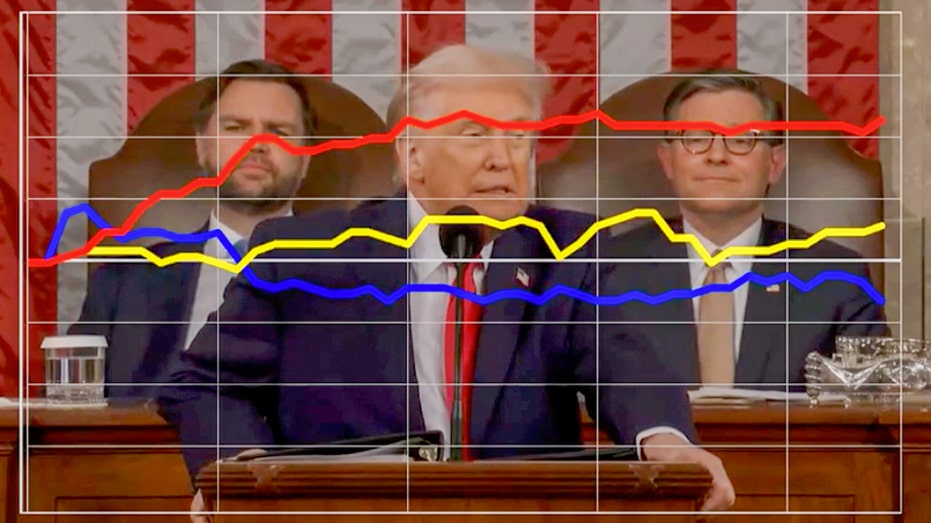
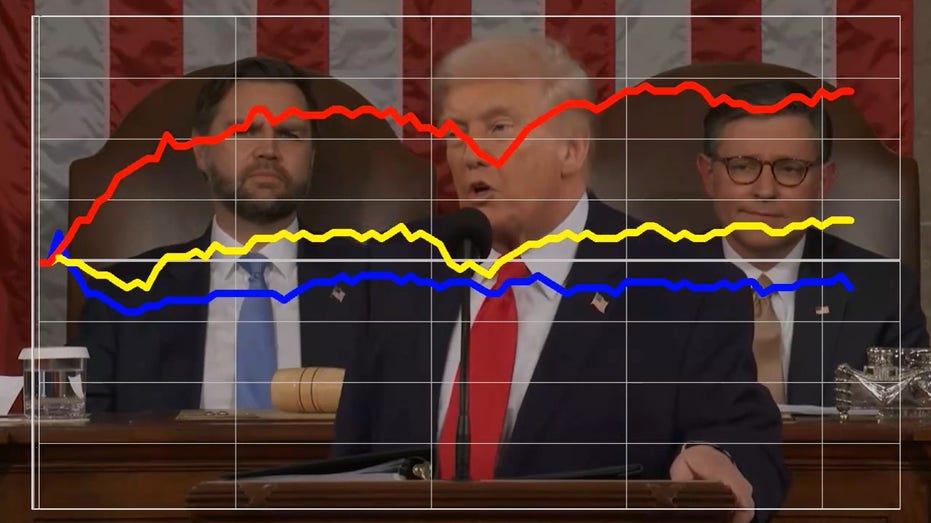
Polling firm Maslansky & Partners assembled a panel representing the nation’s political spectrum – 29 Democrats, 30 Independents, and 40 Republicans – and charted their reactions to President Trump’s speech as a series of fluctuating lines on a graph.
The visual representation was stark: blue for Democrats, red for Republicans, and yellow for Independents, each line spiking with approval or plummeting with disapproval as the President spoke.
Trump began with a surge of positive response from both Republicans and Independents, fueled by claims of significant progress against inflation, asserting his administration had driven core inflation to its lowest level in over five years.
Surprisingly, even among Democratic viewers, support didn’t entirely collapse during this segment, hovering just below the 50% mark as the President highlighted the economic improvements.
The mention of falling gasoline prices ignited particularly strong enthusiasm among Republicans, with the graph reaching its peak as Trump cited prices as low as $1.85 a gallon in some areas.
Independent voters, already engaged, showed their highest levels of approval when the President turned to the topic of mortgage rates, declaring they were the lowest in four years and rapidly decreasing.
He quantified the benefit, stating the annual cost of a new mortgage had fallen nearly $5,000 since he took office – a claim that resonated powerfully with those undecided voters.
However, the overall analysis revealed a more fundamental truth about the speech: it didn’t change minds. It didn’t sway the opposition or broaden the President’s appeal.
Instead, the Maslansky & Partners data indicated the speech primarily served to reinforce existing beliefs, solidifying support among those already inclined to agree and deepening the divide with those who weren’t.
In a political climate increasingly driven by voter turnout, the firm suggested that reinforcement, rather than persuasion, may have been the ultimate goal.
The silent graph, a visual record of raw emotional response, offered a compelling glimpse into the fragmented landscape of American political opinion.