A new engineering blueprint outlines how energy harvesting can eliminate maintenance costs and battery waste in distributed sensor networks. The approach targets large‑scale industrial deployments where battery replacement has become a critical obstacle.
Battery maintenance is emerging as one of the biggest barriers to expansive Industrial IoT installations. Managing thousands of battery‑powered devices quickly erodes project economics.
In response, an engineering consultancy released a document titled “Energy Harvesting: The Key to Maintenance‑Free Industrial IoT.” The guide is intended for hardware developers, design engineers and system architects.
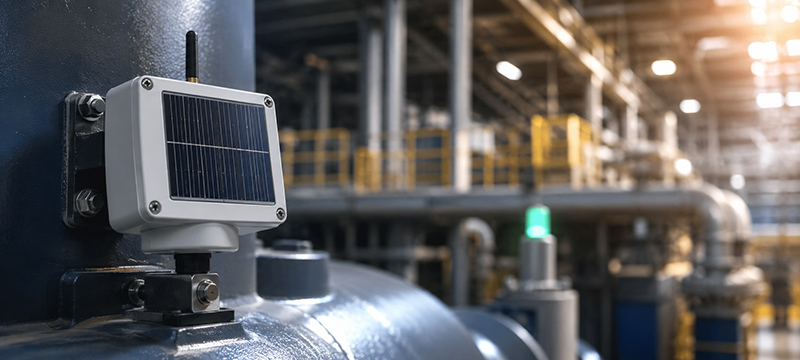
The publication examines commercial and logistical challenges of powering remote, inaccessible and hazardous sensor networks. It details power‑budget calculations, supercapacitor selection and the energy demands of wireless protocols such as LoRaWAN, Zigbee, BLE and NB‑Cellular.
Advances in ultra‑low‑power silicon, power management and energy‑harvesting technologies now enable devices to operate for years using ambient sources like vibration, heat and light. This eliminates the need for routine battery replacement.
Commercial perovskite photovoltaic cells have reached indoor efficiencies of up to 38 percent, significantly improving the viability of self‑powered sensors in warehouses, factories and other indoor environments. The higher efficiency expands the range of applications for maintenance‑free IoT.
A case study from a UK rail project demonstrates a zero‑maintenance trackside backup system. The solution combines solar, wind and train‑induced vibration, managed by an energy‑harvesting integrated circuit and a supercapacitor, to power LoRa transmissions without regular servicing.
The project’s director emphasized that devices drawing microamps with milliamps‑scale pulses can run indefinitely, while continuous draws above 10 mA are impractical for remote locations. Hybrid systems that blend photovoltaic, vibration and thermoelectric inputs are therefore essential.
Energy harvesting alone is insufficient without extreme power conservation, prompting the integration of Edge AI. Low‑power computer‑vision models now perform real‑time object detection entirely on embedded hardware, avoiding cloud dependence.
A recent design engineering expo showcased an Edge AI vision system built on an embedded platform. The demonstration used an on‑board camera and rotating turntable to identify objects instantly, highlighting the feasibility of on‑device machine‑learning inference.
The blueprint also provides a feasibility calculator to help engineering teams assess the suitability of energy‑harvesting solutions. Additional protocol comparisons support early‑stage design decisions for industrial IoT projects.


