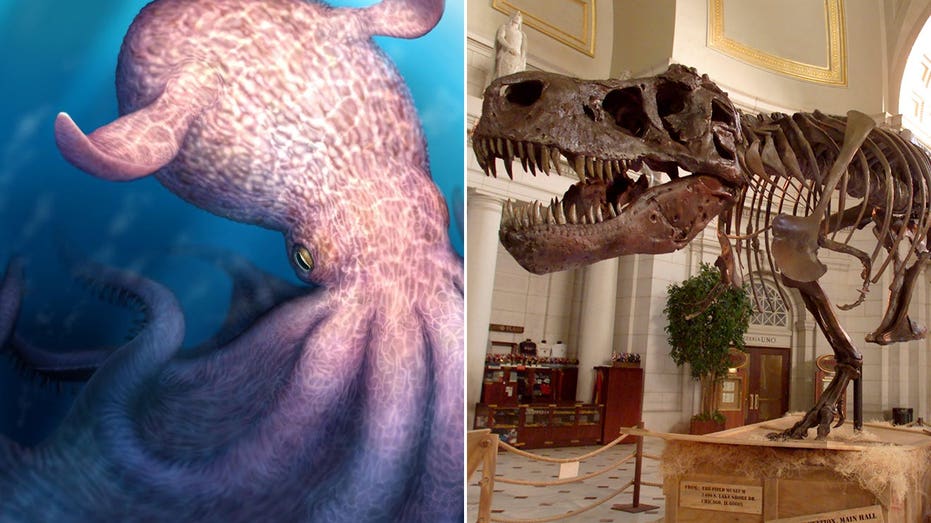
The earliest relatives of octopuses may have been massive predators that roamed the oceans alongside dinosaurs, according to a recent study. These giant cephalopods, which lived around 100 million years ago, were previously thought to have existed 15 million years earlier.
Researchers at Hokkaido University discovered fossilized jawbones in Late Cretaceous rock samples, which were preserved in seafloor sediments found in Japan and Vancouver Island. The team used high-resolution grinding tomography and an artificial intelligence model to locate the fossils, which dated back to 100 to 72 million years ago.
The fossils belonged to a group of extinct finned octopuses known as Cirrata, which were characterized by their powerful jaws. According to the study, these ancient octopuses were capable of crushing their prey with force, leaving behind extensive wear on their jaws.
The extent of wear on the jaws was a surprising finding, with up to 10% of the jaw tip worn away in well-grown specimens. This level of wear is larger than that seen in modern cephalopods that feed on hard-shelled prey, indicating an aggressive feeding strategy.
The findings challenge the previous understanding of predators during the Late Cretaceous period, which was dominated by vertebrate predators. The study provides the first direct evidence that invertebrates could evolve into giant, intelligent apex predators in ecosystems that have been dominated by vertebrates for millions of years.
The research team suggests that powerful jaws and the loss of superficial skeletons were essential characteristics for becoming huge, intelligent marine predators like the ancient octopuses. This new understanding of the evolutionary history of octopuses offers insights into the development of complex predator-prey relationships in ancient ecosystems.


