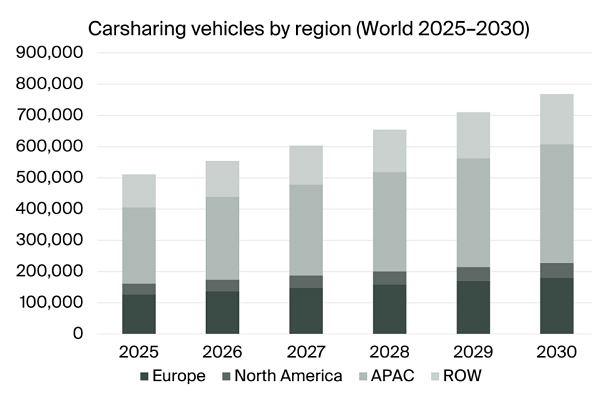
The global public carsharing fleet is projected to experience significant growth over the next five years, according to a recent forecast. By 2030, the number of vehicles used in public carsharing services is expected to reach 768,000, up from 511,000 at the end of 2025, with a compound annual growth rate of 8.5 percent. The user base is also expected to grow, reaching 141.1 million people in 2030, up from 91.0 million in 2025, with a compound annual growth rate of 9.2 percent.
The growth of the carsharing market is being driven by the increasing adoption of connected fleet infrastructure, including telematics, booking systems, and fleet operations software. This infrastructure is essential for the efficient operation of shared mobility services, allowing operators to manage large fleets of vehicles and provide a seamless user experience. Without connected in-vehicle equipment and software platforms, the modern carsharing model would be difficult to operate at scale.
The forecast also highlights the geographical balance of the market, with Asia-Pacific accounting for the largest share of carsharing vehicles, followed by Europe. Europe stands out for its high adoption of free-floating carsharing services, which require operators to manage vehicle availability across a permitted zone, monitor utilisation, and support more dynamic operational decisions.
The growth of the carsharing market is not just about increasing vehicle supply or consumer demand, but rather about the development of a complex ecosystem that relies on in-vehicle telematics, booking management, billing, fleet supervision, dashboards, and analytics. This distinction matters for IoT suppliers, who must provide platforms that can support different types of carsharing services, including station-based and free-floating models.
Carsharing operators are not building this technology themselves, but instead source products and services from specialised vendors. The market includes suppliers offering end-to-end combinations of telematics equipment and carsharing platforms, as well as companies focused on either hardware or software. This presents a practical integration challenge for OEMs and vehicle technology providers, who must ensure that their products can support unattended access, booking workflows, usage-based billing, and operational monitoring.
The shift in focus from market share gains to profitability and higher vehicle utilisation is also significant for technology providers. Operators require better visibility into fleet status, demand patterns, and asset performance, and telematics data becomes a critical part of the business model. This trend is expected to continue, with the corporate carsharing segment adding another dimension to the market.
The operator landscape remains mixed, with specialist providers operating alongside car rental groups and carmaker-backed services. The top 30 carsharing service providers account for around 63 percent of members and manage about 56 percent of the global fleet. For connectivity providers, the opportunity is not limited to SIMs or data plans, but rather the need for reliable connectivity as part of a broader service architecture that includes vehicle access, fleet visibility, and operational control.


