The cellular IoT module market has shown a significant recovery in 2025, according to new data from a leading industry analyst. Annual shipments of cellular IoT modules reached 612 million units, up 33 percent from the previous year, while revenues increased by 19 percent to US$5.6 billion.
The growth in shipments outpaced revenue growth, with the average revenue per shipped module declining year-on-year. This points to a market where demand has recovered, but pricing power remains uneven for OEMs and connectivity hardware vendors.
The rebound in the market is attributed to stronger demand across all major regions, driven in part by the clearing of excess stock in the channel and local policies in selected countries, such as Spain and China. These policies can create concentrated demand for specific module categories, even when broader enterprise IoT spending remains cautious.

The industry analyst forecasts cellular IoT module shipments to grow at a compound annual growth rate of 7 percent through 2030, reaching 878 million units. However, this growth trend is expected to be normalised after the post-inventory rebound, with memory pricing becoming a mounting challenge as memory manufacturers allocate more production capacity to high-bandwidth memory for AI servers and data centre infrastructure.
The growing pressure on module pricing and component costs is creating an unusual cross-market pressure point. Cellular IoT modules are not competing with AI servers in terms of end application, but they are indirectly exposed through shared semiconductor supply chains. The immediate effect has been price pressure rather than outright shortages, with 5G modules most exposed because they typically contain more memory and rely on more advanced DRAM technologies.
The operational consequence is clear: module pricing is becoming less static, and vendors are introducing periodic price reviews and contractual mechanisms to manage component cost volatility. For OEMs and system integrators, this can complicate long-cycle product planning, especially where device business cases depend on stable bill-of-materials costs over multi-year deployments.
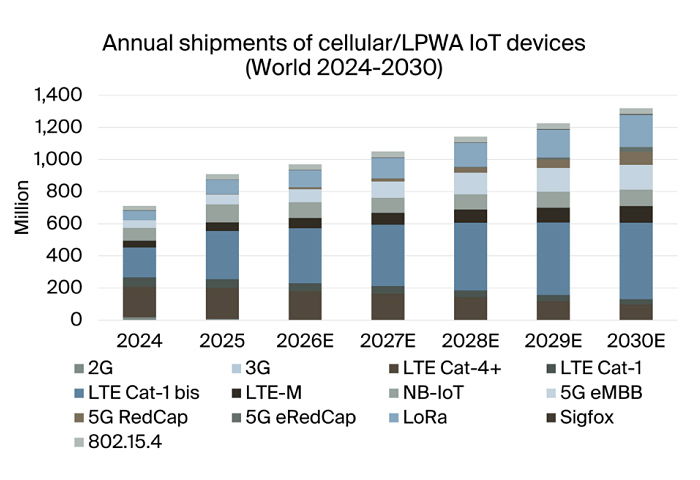
The competitive structure of the module market remains concentrated, with a few vendors dominating the market. However, the regional dynamic is driving the volume leadership, with China-based vendors such as Quectel, China Mobile IoT, Sunsea AIoT, and Fibocom benefiting from large-scale domestic demand.
The chipset picture reinforces the same regional dynamic, with China-based chipset vendors such as ASR Microelectronics, Eigencomm, and Xinyi reporting solid growth in LTE Cat-1 bis and NB-IoT. The market is growing again, but the economics behind that growth are becoming more complex, with low-cost cellular IoT categories scaling, 5G module economics exposed to memory pricing, and vendor choice increasingly depending on the target application, geography, and technology tier.


