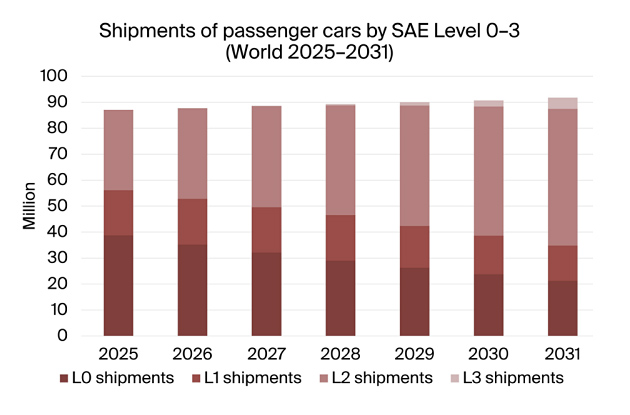
A recent forecast predicts a rapid rise in automated‑driving features, with Level 2 systems expected to appear in 57.3 percent of new cars sold worldwide by 2031 and an advanced subset, termed L2+, reaching a 31.0 percent attach rate.
The industry is shifting focus from the pursuit of full autonomy to scaling driver‑assistance capabilities that can be integrated across mainstream vehicle platforms. Automakers now prioritize which automation level can be produced at volume while meeting regional regulations and product‑liability constraints.
According to the forecast, 55.6 percent of vehicles sold globally in 2025 will meet the requirements for SAE Level 1 automated driving or higher, climbing to 76.9 percent by 2031. The most commercially significant change concerns Level 2 functionality, projected to rise from 35.6 percent of new‑car sales in 2025 to 57.3 percent in 2031.

The advanced L2+ segment, which adds more sophisticated assisted‑driving functions while remaining below conditional automation, is expected to expand sharply. In 2025, 8.0 million new passenger cars—representing a 9.2 percent attach rate—will feature L2+, increasing to 28.4 million vehicles, or 31.0 percent of new sales, by 2031.
Higher automation levels will lag behind. Only 4.8 percent of new cars sold in 2031 are projected to incorporate Level 3 capabilities, and Level 4 vehicles are not expected to achieve meaningful volumes before that year, indicating a market pull toward driver‑supervised systems.
The advantage of L2 and L2+ lies in their ability to be fitted to a broad range of models without the extensive operational and regulatory framework required for Level 3, where the vehicle assumes the driving task under defined conditions. This enables manufacturers to integrate sensors, compute hardware, software, and user‑experience elements at scale while keeping the driver engaged.
Even premium brands that have previously offered Level 3 systems are now de‑emphasizing that technology in favor of the more scalable L2+ approach, reflecting a strategic shift toward broader portfolio deployment.
Chinese manufacturers play a pivotal role in advancing sophisticated L2 and L2+ systems, with several domestic automakers leading the deployment of these features.
Outside China, a range of global automakers provide advanced driver‑assistance solutions, including supervised full‑self‑driving, adaptive cruise control, and lane‑keeping assistance, underscoring the widespread industry adoption of assisted‑driving technology.
The expanding ADAS market involves a complex supply chain that spans Tier 1 system integrators, semiconductor manufacturers, software developers, LiDAR specialists, and mapping providers. Representative firms across these categories are developing the components and platforms needed to support modern assisted‑driving functions.
Growth in ADAS places increasing integration pressure on vehicle manufacturers, which must align compute architectures, perception algorithms, sensor suites, and mapping inputs. Tier 1 suppliers and system integrators are tasked with packaging this complexity into deployable vehicle programs, while semiconductor companies serve as enablers of central compute and electronic content.
LiDAR and high‑definition mapping remain relevant for higher‑end assisted‑driving offerings, with their importance tied to how OEMs choose to differentiate L2+ features beyond camera‑ and radar‑based solutions.
The overall outlook suggests that commercial scale will be achieved through assisted‑driving rather than full autonomy. Enterprises evaluating future vehicle platforms should focus on the specific automation level offered rather than branding, as the mainstream vehicle of 2031 will largely remain a supervised driving system supported by an increasingly intricate technology supply chain.
Level 2 automation can simultaneously control steering, acceleration, and braking, while the driver remains responsible for monitoring the road and must be prepared to intervene at all times.


