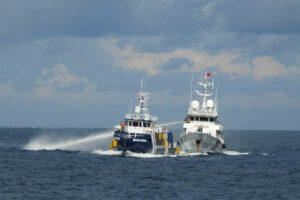
The South China Sea has become a flashpoint, and recent events have dramatically underscored the escalating tensions. Filipino fishermen, simply trying to earn a living, found themselves targeted by Chinese coast guard vessels wielding high-pressure water cannons – a dangerous and unprovoked assault.
The December 12th confrontation left three fishermen wounded and two boats significantly damaged near Sabina Shoal, a contested area claimed by both the Philippines and China. This wasn’t an isolated incident, but part of a disturbing pattern of increasingly aggressive behavior by Beijing.
The United States swiftly condemned China’s actions, labeling them as dangerous and destabilizing. Washington reaffirmed its unwavering support for the Philippines, standing firmly with its ally against what it described as provocative tactics and escalating risks.
China defends its actions, claiming its coast guard was responding to unauthorized presence within waters it considers its own. They accuse the Filipino vessels of deliberately anchoring in the disputed area despite repeated warnings, a narrative sharply contested by Manila.
The core of the dispute lies in China’s expansive “nine-dash line,” a claim to nearly the entire South China Sea that has been invalidated by an international arbitration ruling – a ruling Beijing continues to ignore. This claim overlaps with the rights of several nations, including the Philippines, Vietnam, and Malaysia.
Beyond government responses, a powerful wave of civilian action is rising in the Philippines. A coalition of civil society groups, “Atin Ito” (This Is Ours), is planning increased missions to assert Philippine presence and counter harassment, demonstrating a remarkable display of national resolve.
These civilian voyages, including a recent concert held at sea near Thitu Island, are a direct challenge to China’s claims and a powerful symbol of defiance. They represent a growing determination to protect the Philippines’ sovereign rights in the face of mounting pressure.
The situation is particularly precarious near Second Thomas Shoal, where a grounded Philippine naval ship serves as a vital outpost. Resupply missions to this outpost have repeatedly been disrupted and threatened by Chinese vessels, raising the stakes considerably.
The National Maritime Council of the Philippines has expressed deep alarm, detailing not only the water cannon attacks but also the deliberate cutting of anchor lines, actions that recklessly endangered the lives of the fishermen. The response from the China Coast Guard, citing “necessary control measures,” has been met with outrage.
The Philippines has formally protested these actions, delivering a demarche to the Chinese Embassy in Manila. This diplomatic push underscores the seriousness with which the government views the escalating aggression and its commitment to defending its citizens and its sovereign rights.
The United States has reiterated its commitment to the Philippines through its Mutual Defense Treaty, a crucial deterrent against further escalation. This treaty affirms that an armed attack on Philippine forces in the South China Sea would trigger a US response.
The incident at Sabina Shoal is a stark reminder that the South China Sea dispute is no longer confined to diplomatic exchanges or naval maneuvers. It’s impacting the lives of ordinary people – fishermen and civilians – who are increasingly caught in the crosshairs of geopolitical rivalry.
The future of the South China Sea hangs in the balance, demanding a commitment to peaceful resolution and respect for international law. The courage of the Filipino fishermen and the determination of its citizens are a testament to the enduring spirit of a nation defending its rightful place in the world.