High in the Italian Alps, a breathtaking discovery has rewritten the story of prehistoric life. A wildlife photographer, seeking images of deer and vultures, instead unearthed a treasure trove of dinosaur footprints – a collection so vast and ancient it surpasses imagination.
The footprints, numbering in the tens of thousands and stretching across five kilometers, date back an astonishing 210 million years to the Triassic Period. This remarkable find occurred within Stelvio National Park, a region bordering Switzerland that was once a prehistoric coastline, and surprisingly, had never before revealed such evidence of dinosaur life.
Paleontologist Cristiano Dal Sasso described the moment he received the call from photographer Elio Della Ferrera as a moment where “reality really surpasses fantasy.” The sheer scale of the discovery, and its pristine preservation, left experts stunned.
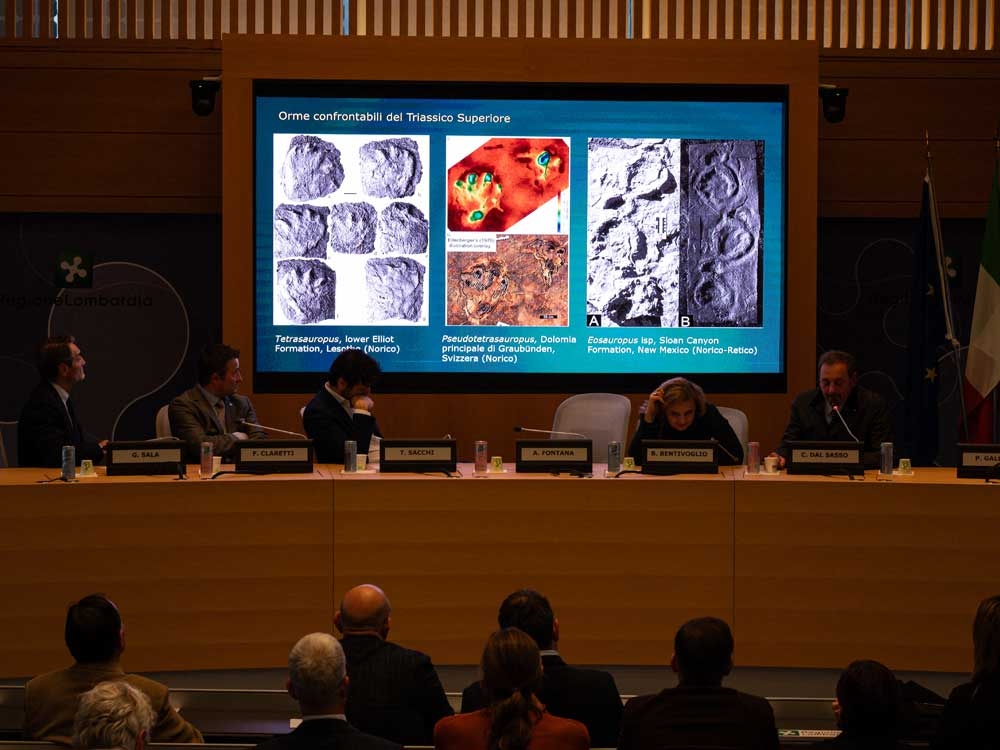
These ancient tracks were left by massive, long-necked herbivores, walking on two legs and reaching lengths of up to ten meters (33 feet). Weighing in at four tons, these giants resembled the Plateosaurus, leaving behind footprints a striking 40 centimeters wide, complete with visible claw marks.
The patterns within the tracks tell a compelling story. Dinosaurs didn’t wander aimlessly; they travelled in coordinated packs, occasionally pausing in circular formations – a possible defensive strategy against predators in a long-lost world.
Evidence suggests a deliberate, unhurried pace. “There are very obvious traces of individuals that have walked at a slow, calm, quiet rhythmic pace, without running,” Dal Sasso explained, painting a picture of these colossal creatures moving through their ancient environment.
Della Ferrera’s initial focus was far from dinosaurs. While photographing wildlife in September, his camera caught something unusual on a sheer vertical rock face, nearly 2,000 feet above the nearest road. Driven by curiosity, he painstakingly scaled the wall to investigate.
The difficulty in spotting the tracks was significant. The north-facing wall remained largely in shadow, and a powerful lens was required to discern the ancient impressions. Yet, Della Ferrera’s persistence revealed an unparalleled abundance of footprints, remarkably well-preserved despite the passage of eons.
The discovery site lies just two kilometers from Bormio, the mountain town slated to host Men’s Alpine skiing during the upcoming Winter Games. While access to the site remains challenging, particularly during winter, the find is being celebrated as an extraordinary gift.
Though plans for public access are still being considered, the unveiling of this prehistoric treasure promises to reshape our understanding of the Triassic Period and the dinosaurs that once roamed the Italian Alps, offering a glimpse into a world lost to time.