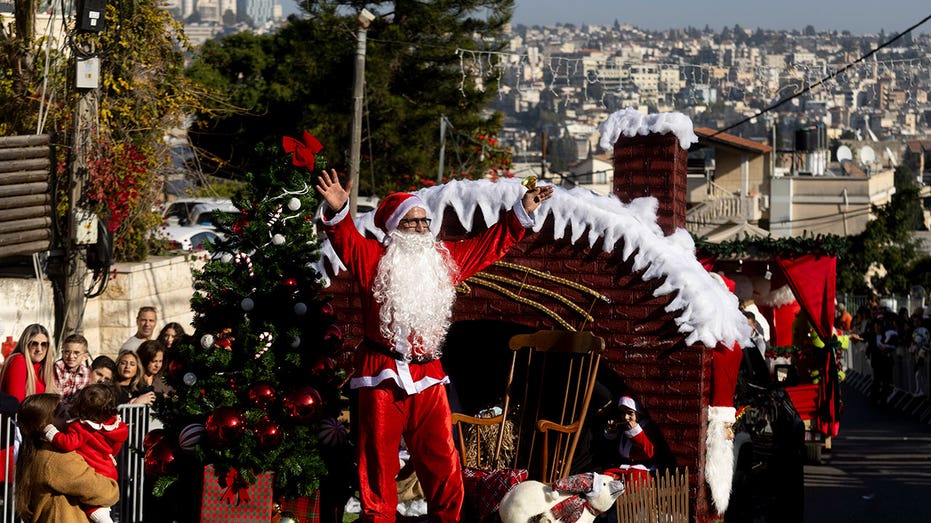
This Christmas, a stark contrast unfolded in the two cities most sacred to Christianity: Bethlehem and Nazareth. While both welcomed celebrations after years of disruption, the spirit of the season resonated with profoundly different tones, revealing a complex reality for Christians in the Holy Land.
In Nazareth, a vibrant confidence filled the streets. Festivities flourished, fueled by a steadily growing Christian population within Israel. This wasn’t merely a return to tradition; it was a demonstration of a community thriving under a system that fostered its growth and security.
Bethlehem, the birthplace of Jesus, told a different story. Celebrations were tinged with anxiety, a fragile attempt at normalcy against a backdrop of decades-long decline. The very future of the Christian community there hangs in the balance, shadowed by dwindling numbers and growing fear.
The numbers paint a sobering picture. In 1950, Christians comprised 86% of Bethlehem’s population. Today, that figure has plummeted to roughly 10%. Recent events have only accelerated the exodus, with at least 142 Christian families leaving the area since October 7th, seeking safety and a future elsewhere.
Those leaving aren’t simply reacting to isolated incidents. They perceive a systemic vulnerability, a realization that minority communities require robust protection to survive in a volatile region. The events of October 7th served as a stark warning, highlighting the precariousness of their position.
The situation in Nazareth stands in sharp relief. Here, Christians represent approximately 2% of Israel’s population, yet boast the highest GDP per capita among all religious groups – Jews, Muslims, and Druze alike. They enjoy full rights, respect, and genuine protection under Israeli governance.
This prosperity hasn’t materialized by chance. Since the 1990s, while Bethlehem’s Christian community has been decimated, Nazareth has flourished. The difference, observers say, lies in governance and security – a stable environment where faith can be practiced freely and communities can thrive.
Despite the challenges, Bethlehem attempted to project an image of resilience this Christmas. Manger Square glowed with lights, and religious ceremonies unfolded at the Church of the Nativity. But for many, these displays felt like a carefully constructed facade.
Some view the Palestinian Authority’s emphasis on Christmas celebrations as a strategic effort to present a moderate image to the world, particularly as discussions about Gaza’s future continue. However, recent incidents contradict this narrative, revealing a darker undercurrent of hostility.
In the weeks leading up to Christmas, Christians in the region faced threats against churches, violent assaults linked to land disputes, and a pervasive atmosphere of intimidation. These actions, some allege, are driven by extremist ideologies and supported by external actors.
A church in Jenin was firebombed, and a Christmas tree was deliberately set ablaze outside another church. These incidents prompted Israel’s Foreign Ministry to issue a warning about “growing hostility toward Christians” under Palestinian Authority control.
In contrast, Israeli Prime Minister Benjamin Netanyahu affirmed Israel’s commitment to protecting its Christian population, stating that it is the only country in the Middle East where Christians can practice their faith with full rights and freedom, embraced and deeply appreciated.
The fear is palpable. In nearby Beit Jala and Nablus, Christian residents reportedly avoided public displays of festivity, fearing harassment. Many feel unable to speak openly about their concerns, forced to survive “quietly” under immense pressure.
Official statistics underscore the diverging trends. As of Christmas Eve 2025, approximately 184,200 Christians reside in Israel, representing a 0.7% growth in 2024 – a rare instance of a Christian community expanding in the Middle East. This growth is largely centered in Nazareth, Haifa, and Jerusalem.
The contrast between Nazareth and Bethlehem isn’t simply a matter of politics; it’s a story about systems. One system, it’s argued, actively protects religious freedom and allows ancient Christian communities to endure, while the other struggles to provide even basic security and respect.
As the Christmas lights dim and international attention shifts, a critical question remains: will the plight of Bethlehem’s Christians be forgotten, or will it finally inspire lasting protection for one of Christianity’s oldest and most vulnerable communities?