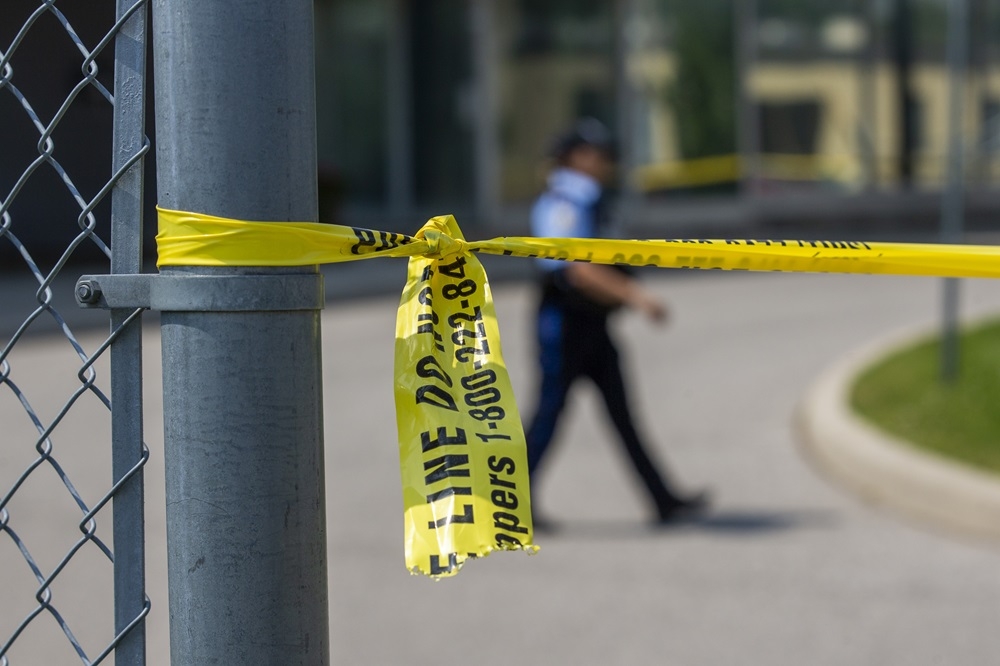
The weight of a lost fortune, the sting of betrayal, and a desperate act of finality. In June 2024, Alan Kats, driven to the brink by a devastating financial scam, walked into an office building and unleashed a fury born of utter ruin.
His targets: Arash Missaghi and Samira Yousefi, individuals he believed had systematically stolen his family’s life savings. Before the echoes of gunfire faded, Kats turned the weapon on himself, leaving behind a handwritten note – a desperate plea to “Stop these criminals.”
The note named not only his alleged tormentors but also lawyers he accused of enabling their predatory scheme, including Shahryar Mazaheri. This single act of desperation ignited a firestorm, exposing a web of deceit and raising serious questions about professional responsibility.
Five months later, Mazaheri faced provisional suspension by the Law Society, as investigators began to unravel the story of a $1.4 million loss – a loss that had cost Alan Kats and his wife, Alisa Pogorelovsky, their home and ultimately, their future.
Mazaheri maintains he was unaware of the fraud, but his attempts to clear his name have been deeply flawed. Recent proceedings revealed a startling reliance on artificial intelligence, resulting in legal arguments riddled with nonsensical claims and references to nonexistent cases.
The tribunal’s assessment was blunt: “Substantial parts…made no sense, referring to non-existent and misleading authorities.” It was a self-inflicted wound in a battle for his professional life.
The tragedy began in 2022, when Kats and Pogorelovsky, seeking investment opportunities in mortgages, were guided by Yousefi. They leveraged their assets, borrowing $1.375 million, and invested $850,000 in a syndicated loan and $400,000 in a private mortgage – funds entrusted to Mazaheri.
But the money vanished into a black hole, diverted by Missaghi’s companies and never reaching the intended investments. The Law Society itself acknowledged Missaghi as a known fraudster, a figure already linked to other legal malfeasance.
Evidence suggests Mazaheri lacked the necessary expertise in syndicated mortgages and played a limited role in the transaction. The tribunal concluded there were “reasonable grounds for believing” he did not have the authority he now claims to have had when disbursing Pogorelovsky’s funds.
As the promised returns failed to materialize, the couple discovered the horrifying truth: no mortgages existed for the properties they believed they had invested in. A civil lawsuit was launched, but the wheels of justice turned agonizingly slowly.
Pogorelovsky also filed a complaint with the Law Society in January 2024, prompting a request for Mazaheri’s files in April. But the investigation proved too late to save Alan Kats from his despair.
On June 17th, he acted. “Alan could not handle losing our life’s savings,” Pogorelovsky stated, her voice heavy with grief. “The events…have devastated and now destroyed our family.”
The Law Society’s investigation continues, focusing on whether Mazaheri was “wilfully blind” to the fraud, given Missaghi’s known history and Mazaheri’s limited experience in this complex area of finance. They suggest he may have been unknowingly used as a tool, now desperately attempting to retroactively justify his actions.
Mazaheri’s attempt to lift his suspension in September 2024 backfired spectacularly. His reliance on AI, intended to bolster his defense, instead exposed the fragility of his arguments and prompted a sincere, if belated, apology for failing to verify the AI’s output.
The fight for his license remains unresolved, a stark reminder of the devastating consequences of alleged fraud and the profound impact it can have on individuals and families. The case serves as a chilling illustration of how easily trust can be shattered and lives irrevocably altered.