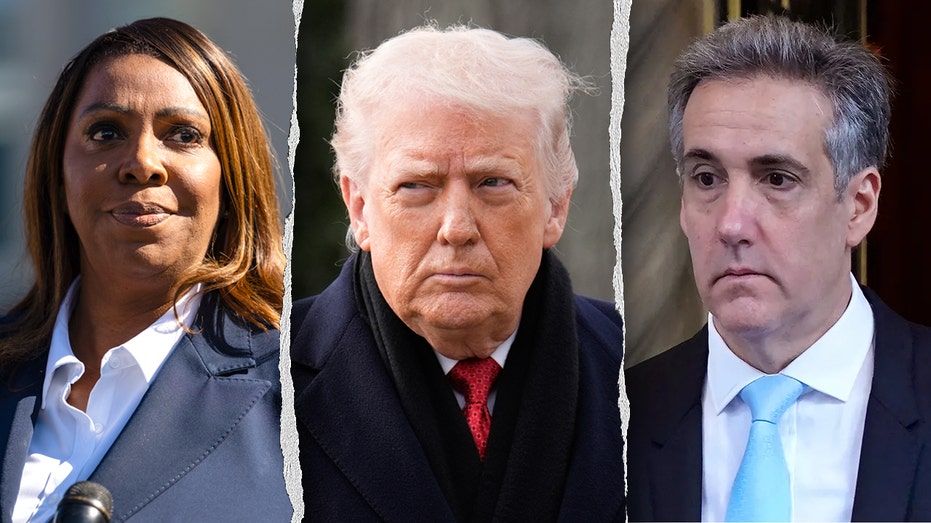
Michael Cohen, once Donald Trump’s most trusted legal advisor, has ignited a firestorm with explosive allegations. He claims prosecutors in New York deliberately steered his testimony to ensure convictions against his former client, revealing a disturbing undercurrent of political motivation within the legal proceedings.
Cohen asserts that both New York Attorney General Letitia James and Manhattan District Attorney Alvin Bragg weren’t interested in a full, unbiased account. Instead, he alleges they actively sought only information that reinforced their pre-existing desire to build a case – and secure a guilty verdict – against Trump.
His accusations, detailed in a recent public statement, paint a picture of relentless pressure. Cohen felt “coerced” into tailoring his statements, providing only the evidence that aligned with the prosecution’s narrative, fearing repercussions if he deviated.
This revelation comes as Trump seeks to move his hush money case to federal court, adding another layer of complexity to an already contentious legal battle. Cohen’s testimony was central to both the civil fraud case brought by James and the criminal trial led by Bragg.
In the civil case, Trump was found liable for inflating his assets, while the criminal trial resulted in 34 convictions for falsifying business records. Cohen’s presence on the stand was pivotal in both outcomes, making his current claims particularly damaging.
He doesn’t portray himself as a sympathetic figure, acknowledging his own past legal troubles – including convictions for tax evasion and lying to Congress. However, he insists his motivation isn’t to defend Trump, but to expose a dangerous pattern of prosecutorial overreach.
Cohen alleges that the prosecutors saw these high-profile cases as opportunities to advance their own careers, seeking recognition as the officials who “took down Trump.” This pursuit of personal glory, he argues, compromised the integrity of the justice system.
He describes a pattern of leading questions designed to elicit specific answers, effectively shaping his testimony to fit the prosecution’s desired outcome. When his initial responses didn’t align with their goals, he claims they relentlessly pushed for answers that did.
Cohen’s decision to speak out now, he explains, stems from a deep concern about the erosion of justice. He believes prosecutors should pursue truth, not predetermined targets, and warns of the devastating consequences when that principle is abandoned.
He vividly recalls feeling compelled to provide the “right” answers, hoping for leniency in his own sentencing. This created a chilling dynamic, where cooperation wasn’t about honesty, but about securing a reduced punishment.
The core of Cohen’s accusation is a disturbing claim: that the pursuit of justice was overshadowed by political ambition. He believes the lines between law enforcement and political maneuvering were blurred, ultimately damaging the credibility of both the prosecutors and the legal system itself.

![ZELDIN SHAMBLES: Caught EXPOSING Why He Doesn't Care About American Jobs! [VIDEO]](https://www.thegatewaypundit.com/wp-content/uploads/2026/01/lee-zeldin-in-detroit-1200x630.jpg)