The 2026 Super Bowl halftime presented a stark choice to over 100 million viewers: a global music icon in Bad Bunny, or a defiant alternative curated by a politically charged organization. It wasn’t just a musical difference; it was a cultural collision unfolding on the nation’s biggest stage.
The NFL’s selection of Bad Bunny, a Puerto Rican artist who frequently sings in Spanish and has openly criticized past administrations, ignited a firestorm. This wasn’t typical Super Bowl counterprogramming; it was a direct response, fueled by political opposition and a brewing cultural war.
Turning Point USA seized the moment, launching the “All-American Halftime Show” featuring Kid Rock and a lineup of country artists. The intent was clear: a pointed contrast to Bad Bunny’s performance, appealing to a specific segment of the American audience.
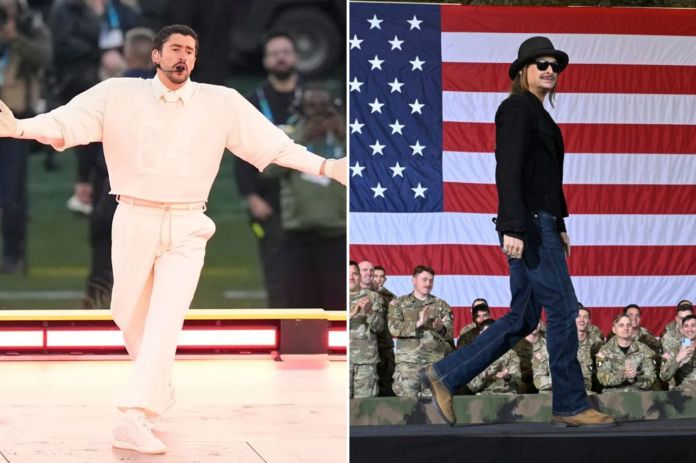
As the clock ticked down, Bad Bunny took the field at Levi’s Stadium, clad in a striking white suit. He launched into “Titi Me Pregunto,” immediately captivating the stadium with his energy and unique style.
The 13-minute performance was a vibrant celebration of his music, featuring 14 hits and a visually stunning island-themed set – a clear homage to his Puerto Rican roots. A surprise appearance by Lady Gaga added another layer of excitement to the spectacle.
Despite singing entirely in Spanish, Bad Bunny subtly acknowledged his audience, offering a heartfelt “God Bless America” and displaying a football emblazoned with “Together, we are America.” He even included a poignant nod to his recent Grammy acceptance speech, referencing the need to protect communities from ICE.
The show culminated in a powerful display of unity, as performers raced across the field carrying flags representing nations throughout the Western Hemisphere, with the American flag prominently displayed.
Meanwhile, Turning Point’s alternative show began with a rousing rendition of “The Star-Spangled Banner” on electric guitar. Brantley Gilbert, Gabby Barrett, and Lee Brice warmed up the crowd before Kid Rock took the stage.
Kid Rock, a staunch supporter of a former president, exploded onto the scene with “Bawitdaba,” instantly energizing the venue. He followed with a cover of Cody Johnson’s “Til You Can’t,” solidifying the show’s country-focused identity.
Held in a smaller venue adorned with patriotic imagery, the “All-American Halftime Show” still managed to attract a significant online audience. The YouTube stream peaked at nearly 4.8 million viewers during the 30-minute broadcast.
The reaction from a former president was swift and scathing. In a post on social media, he labeled Bad Bunny’s performance “absolutely terrible” and “an affront to the Greatness of America.”
He criticized the Spanish lyrics, the dance routines, and the overall presentation, claiming it lacked “standards of Success, Creativity, or Excellence.” The post underscored the deep cultural and political divisions at play.
The Super Bowl halftime wasn’t just about entertainment; it became a battleground for competing ideologies, a moment where music and politics collided on a massive scale, leaving a lasting impression on the American cultural landscape.