The 2026 Super Bowl halftime presented a stark choice to over 100 million viewers: a global music icon in Bad Bunny, or a defiant alternative curated by a politically charged organization. It wasn’t just a musical difference; it was a cultural collision unfolding on the nation’s biggest stage.
The NFL’s selection of Bad Bunny, a Puerto Rican artist who predominantly sings in Spanish, ignited a firestorm of controversy. Outspoken criticism of past political actions fueled a boycott, led by figures from the previous administration and their supporters, who conspicuously avoided the game itself.
In response, Turning Point USA launched the “All-American Halftime Show,” a counter-performance featuring Kid Rock and a lineup of country artists. This wasn’t simply counterprogramming; it was a deliberate statement, a challenge to the evolving cultural landscape of America.
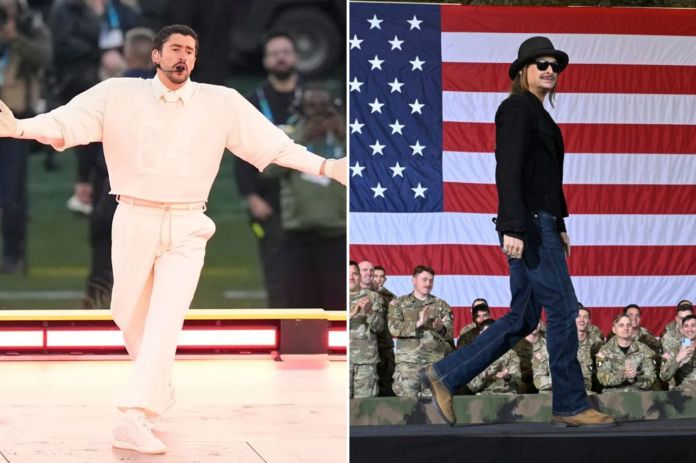
Bad Bunny took the field at Levi’s Stadium, immediately dispelling rumors of a dramatic outfit with a sleek, all-white suit. He launched into a vibrant 13-minute set, performing 14 hits that resonated with millions worldwide.
The stage transformed into a tropical island, a clear homage to his Puerto Rican roots. A surprise appearance by Lady Gaga added another layer of spectacle, though Bad Bunny himself remained steadfastly in Spanish, offering a brief “God Bless America” as a gesture of inclusion.
The performance culminated in a powerful visual display: performers racing across the field carrying flags representing nations across the Western Hemisphere, with the American flag prominently featured. It was a celebration of unity, subtly underscored by a nod to his recent Grammy’s speech, referencing immigration concerns.
Meanwhile, Turning Point’s alternative show began with a stirring rendition of “The Star-Spangled Banner” on electric guitar. Brantley Gilbert, Gabby Barrett, and Lee Brice warmed up the crowd before Kid Rock, a vocal supporter of the previous administration, took the stage.
Kid Rock’s entrance, set to the energy of “Bawitdaba,” ignited the smaller venue, decorated with patriotic imagery. Though dwarfed in scale by Levi’s Stadium, the event drew a significant online audience, peaking at nearly 5 million viewers on YouTube.
The reaction from the previous administration was swift and scathing. A lengthy post on a social media platform dismissed Bad Bunny’s performance as “absolutely terrible” and “an affront to the Greatness of America,” criticizing the language and choreography.
The statement continued, lamenting the lack of understanding of the lyrics and deeming the performance unsuitable for young viewers. It was a passionate defense of traditional values, framed as a rejection of a changing cultural tide.
Figures aligned with the previous administration publicly endorsed Turning Point’s show, framing it as a patriotic alternative. The Super Bowl halftime wasn’t just a musical event; it had become a battleground for cultural and political ideologies.