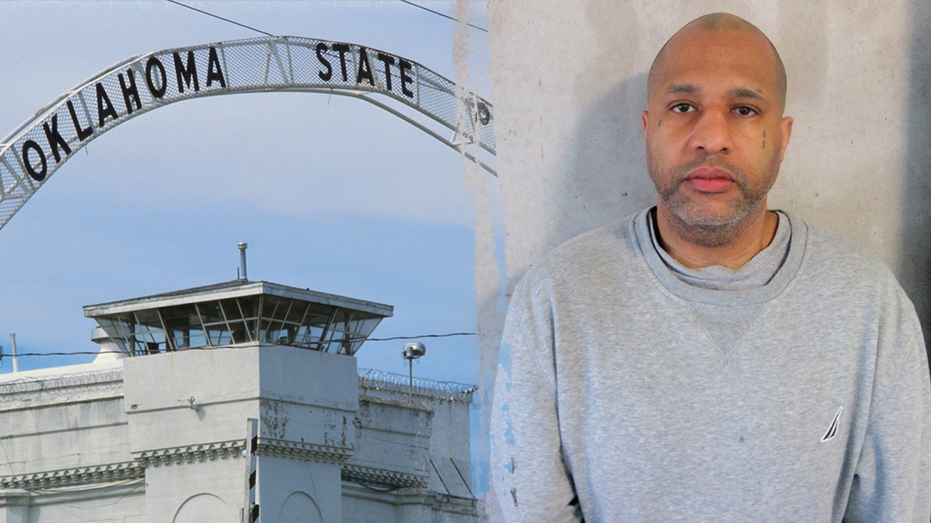
A final, defiant smile. That’s what haunted the sister of one victim as Kendrick Simpson, convicted of a brutal double homicide, received a lethal injection Tuesday at the Oklahoma State Penitentiary. His last words, a startling expression of affection to his supporters, contrasted sharply with the grief etched on the faces of those who had lost loved ones.
The case stemmed from a 2006 altercation at an Oklahoma City nightclub. Simpson, 45, fatally shot Anthony Jones, 19, and Glen Palmer, 20, after following their car from a gas station. Prosecutors detailed a calculated act of violence, a pursuit ending in tragedy.
Inside the death chamber, Simpson offered a seemingly serene farewell. “I love y’all,” he told those who had come to witness his final moments. “Thank y’all for being here to support me.” The words, delivered with a composure that deeply disturbed the victims’ families, lingered in the air.
Crystal Allison, Palmer’s sister, described being frozen by a familiar expression. “The same smile that had been tormenting me for 20 years, he still smiled that same smile laying on his deathbed,” she recounted, the image seared into her memory.
The execution itself was swift, lasting less than 15 minutes. Rev. Don Heath, Simpson’s spiritual advisor, offered scripture as doctors monitored his condition. Within five minutes, Simpson was determined to be unconscious, and he was later pronounced dead.
Attorney General Gentner Drummond released a statement, expressing hope that the execution would offer a measure of closure to the families of Jones and Palmer. “Justice has been served,” he wrote, acknowledging the unimaginable pain they had endured for two decades.
Simpson’s final meal was a stark contrast to the gravity of the situation: a bacon cheeseburger, large onion rings, and a strawberry milkshake. It was a last taste of normalcy before facing the ultimate consequence.
Defense lawyers had argued that Simpson suffered from PTSD, a consequence of the upheaval following Hurricane Katrina. He had relocated to Oklahoma City from New Orleans in 2005, seeking refuge from the storm’s devastation. Ironically, Simpson himself was a survivor of gun violence, having been shot five times in a New Orleans drive-by shooting in 2004.
During a clemency hearing earlier in January, Simpson offered a direct apology for his actions. He took full responsibility, stating, “I don’t make any excuses…they didn’t deserve what happened to them.” However, the Pardon and Parole Board ultimately denied his request for clemency, and the U.S. Supreme Court upheld the decision.
Simpson’s execution was the first in Oklahoma this year, and the second in the United States. Ronald Palmer Heath was put to death in Florida on the same day, convicted of a 1989 murder during an armed robbery. The weight of these events reverberated across the nation, a somber reminder of the finality of justice.