Robinhood’s recent earnings report revealed a company at a crossroads, despite record financial gains. While revenue surged to $1.28 billion in the fourth quarter – a 27% jump year over year – and full-year revenue climbed to $4.5 billion, a substantial 52% increase, investors reacted with caution.
The core of the concern lies in Robinhood’s accelerating focus on prediction markets, a rapidly expanding area where users wager on the outcomes of events. These markets have seen explosive growth, with contract volumes more than doubling in the last quarter and exceeding 12 billion trades in the past year.
CEO Vlad Tenev envisions a “prediction market super cycle,” potentially driving trillions in annual volume, fueled by global events and a new joint venture called Rothera. He believes this expansion will move beyond sports, offering contracts on a wider range of possibilities.

However, a candid admission during the earnings call ignited a wave of criticism. Tenev revealed that a growing number of new customers are arriving not to invest in traditional stocks or cryptocurrency, but specifically for the prediction markets. The company’s strategy then involves “cross-selling” these users into long-term investment products like retirement accounts.
This approach drew immediate backlash, with many questioning whether Robinhood was effectively functioning as a gambling platform and then attempting to leverage those users for more conventional financial services. The image of attracting customers with short-term bets only to pitch them retirement plans resonated negatively.
The concern is that this shift undermines Robinhood’s original promise as a platform for long-term investing. While the company points to expanding beyond sports – citing a successful contract based on a potential government shutdown – the perception remains tied to speculative, high-frequency trading.

Executives attempted to reassure investors, highlighting the increasing diversification of prediction markets and improved monetization through the Rothera venture. They emphasized that non-sports contracts are gaining traction and that greater control over pricing will boost profitability.
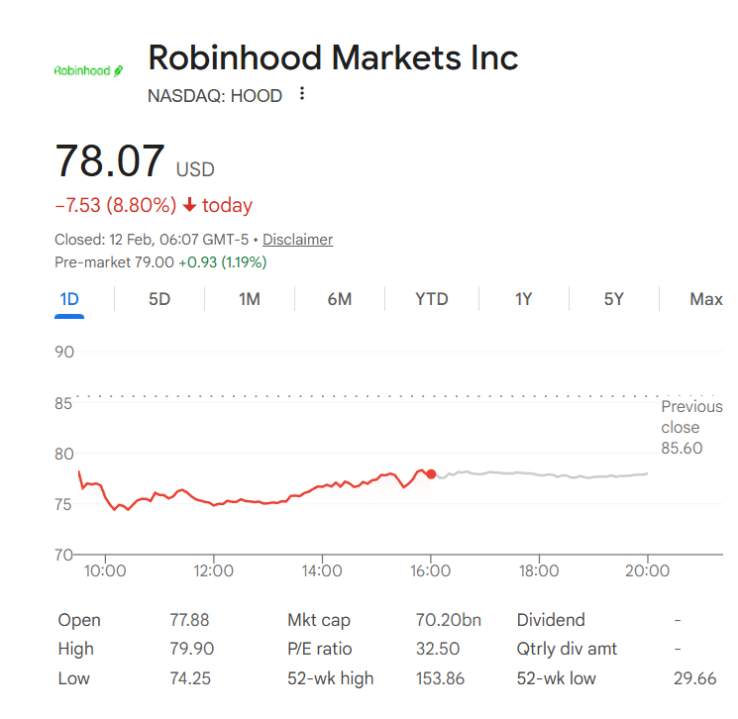
Despite these assurances, the market remained skeptical. Robinhood’s stock price plummeted nearly 9% following the earnings release, closing at $78.07, a significant drop from the previous day’s $85.60. This reaction signals a lack of confidence that the rapid growth in prediction markets will translate into sustainable, high-quality earnings.
Ultimately, investors are questioning whether users attracted by the thrill of prediction markets will genuinely embrace the discipline of long-term investing and wealth building, or if this represents a fleeting surge in activity with limited lasting value.