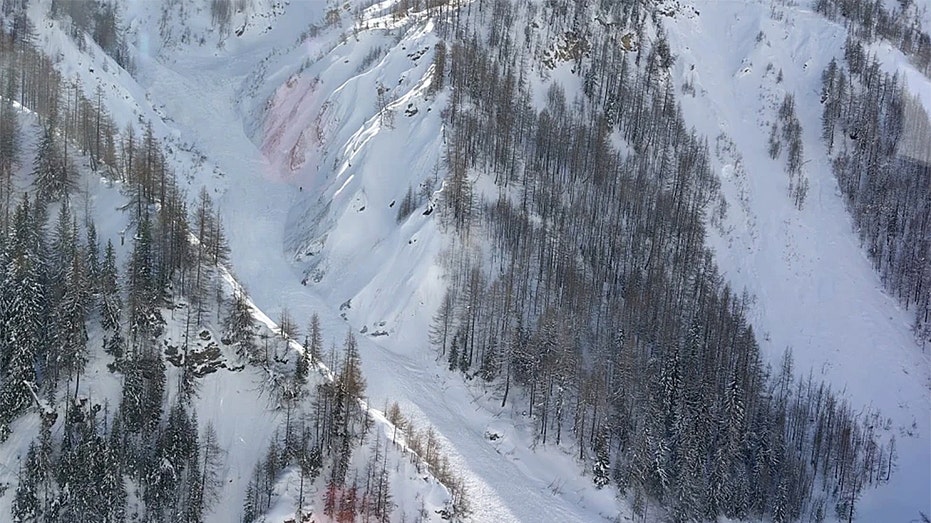
The majestic slopes of the Mont Blanc massif, a breathtaking panorama straddling the borders of Italy, France, and Switzerland, became a scene of tragedy this Sunday. An avalanche, unleashed upon a popular freeride route, claimed the lives of two skiers and left another critically injured, shattering the serenity of the Italian Alps.
The disaster unfolded along the Couloir Vesses, a notorious off-piste descent in Courmayeur’s Val Veny, known for its challenging terrain and alluring powder. Three skiers were caught in the sudden cascade of snow, swept away by the immense force of nature. A massive rescue operation was immediately launched, mobilizing fifteen rescuers, three specialized canine units, and two helicopters against the unforgiving mountain.
Despite the swift response, one of the injured skiers succumbed to their injuries after being transported to a hospital. The news cast a somber shadow over the region, a stark reminder of the inherent risks associated with backcountry skiing. Simultaneously, a separate incident in Trentino saw a skier partially buried, thankfully rescued by quick-thinking companions.
This deadly slide isn’t an isolated event. The Italian Alps are currently experiencing a period of exceptionally high avalanche danger, marked by a tragically high death toll. In the week leading up to February 8th, thirteen skiers, climbers, and hikers lost their lives in the Italian mountains – a grim record, with avalanches responsible for ten of those fatalities.
The root of the problem lies in a dangerously unstable snowpack. Recent storms have piled fresh snow onto fragile layers beneath, while powerful winds have sculpted treacherous drifts. These conditions create a landscape where avalanches can be triggered with alarming ease, even by the passage of a single person.
Experts warn that identifying these hazardous zones is incredibly difficult, even for seasoned professionals. “Persistent weak layers” hidden within the snowpack are often concealed by seemingly harmless fresh snow or wind drifts, making detachments unpredictable and devastatingly swift. The entire Alpine arc, bordering France, Switzerland, and Austria, is affected.
The allure of pristine powder following recent snowstorms has drawn a surge of visitors to the region, unfortunately contributing to a proportional increase in accidents and fatalities. The mountains, while beautiful, demand respect and a thorough understanding of the risks involved.
Courmayeur, a charming town nestled in the mountains, approximately 124 miles northwest of Milan, finds itself grappling with this tragedy as the Milan-Cortina Winter Olympics commence. While the events unfold, authorities are keen to reassure the public about the safety of designated competition areas.
Officials have emphatically stated that competition sites – located in Lombardy, Cortina d’Ampezzo, and Val di Fiemme – are meticulously maintained, constantly monitored, and pose no immediate danger to athletes or spectators. Rigorous safety measures are in place, ensuring a secure environment for the Olympic games.
Even before the games began, emergency crews were actively reinforcing safety protocols throughout the Olympic venues, prioritizing the well-being of all visitors. The contrast between the controlled environment of the competition sites and the unpredictable dangers of the backcountry serves as a poignant reminder of the power and peril of the mountains.