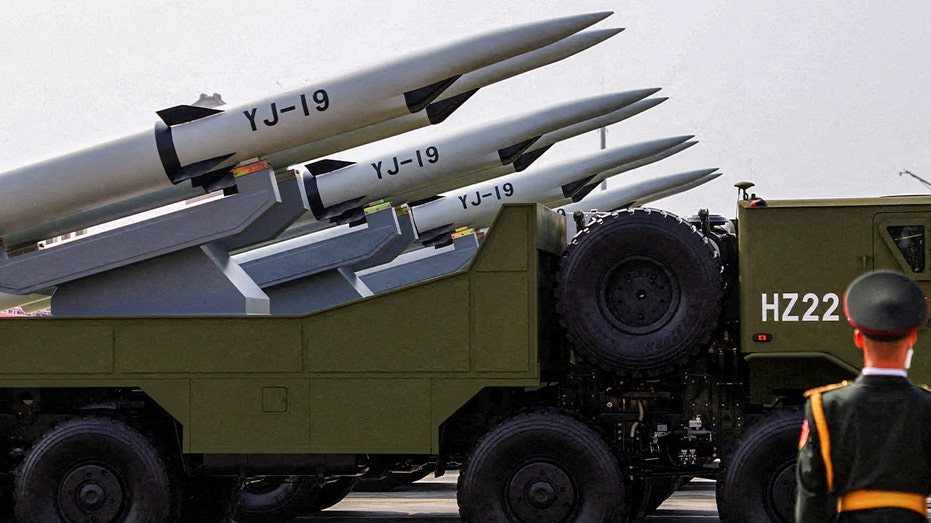
For decades, China has been meticulously constructing a formidable land-based missile force, a silent arsenal designed to deter the United States from intervening in a potential conflict over Taiwan. Now, U.S. officials reveal this force poses a sweeping threat, capable of reaching every major airfield, port, and military installation throughout the Western Pacific.
As Washington urgently strives to develop its own long-range firepower, analysts caution that the land domain – often overshadowed – may prove to be the most critical factor in a U.S.-China confrontation. The coming contest won’t be defined by traditional warfare, but by missile ranges, secure base access, and the ability of U.S. forces to endure the initial, devastating barrage.
The People’s Liberation Army Rocket Force (PLARF) has amassed an unprecedented inventory of short, medium, and long-range missiles. These weapons can now reach across the first, and increasingly, the second island chains, fundamentally altering the strategic landscape.
Recognizing a potential disadvantage in direct air combat, China strategically invested in land-based firepower. The PLARF became the solution: a massive, distributed force intended to neutralize U.S. bases and keep American air and naval assets out of the fight.
This has resulted in the world’s largest theater-range missile stockpile, protected by hardened underground facilities, highly mobile launchers, and rapid “shoot-and-scoot” tactics designed to overwhelm any defense. Despite China’s numerical superiority, the U.S. maintains key advantages in targeting precision and force survivability.
American missiles – Tomahawks, SM-6s, and emerging hypersonic weapons – are integrated into a sophisticated global surveillance network that the PLARF cannot yet replicate. This network relies on satellites, undersea sensors, stealth drones, and decades of accumulated combat experience.
While China’s missile force is immense, it lacks the practical experience of its American counterpart. The PLARF hasn’t engaged in large-scale conflict since the 1970s, creating challenges in coordinating complex, multi-service operations.
The U.S. is actively addressing its own vulnerabilities, particularly in missile stockpiles. Current estimates suggest that long-range munitions would be depleted within a week of conflict over Taiwan. A rapid expansion of ground-launched weapons production is underway to address this critical shortfall.
New Army systems – Typhon launchers, high mobility artillery rocket systems, precision strike missiles, and long-range hypersonic weapons – are being deployed to hold Chinese forces at risk from significantly greater distances. This shift is happening at a substantial scale, with plans to field roughly 15,000 long-range anti-ship missiles by 2035, a dramatic increase from the current 2,500.
China’s strategy centers on overwhelming U.S. bases early in a conflict. The U.S. response relies on layered air defenses – Patriot batteries, THAAD interceptors, and Aegis-equipped destroyers – designed to intercept missiles at various altitudes and ranges.
However, analysts emphasize the need for a more diverse and affordable missile defense system. Expanding this defensive capability is crucial to countering the sheer volume of potential attacks.
A significant U.S. advantage lies in its ability to launch long-range strikes from submarines. These vessels can fire cruise missiles from virtually anywhere in the Western Pacific, remaining undetected and invulnerable to Chinese fire – a capability China currently lacks.
Command integration is another area where the U.S. excels. American units routinely train in multi-domain operations, seamlessly integrating cyber, space, electronic warfare, and precision fires. This level of coordination remains a challenge for the PLARF.
Furthermore, China’s defense industry faces internal hurdles. Many of its firms are state-owned enterprises, often plagued by inefficiency, quality control issues, and maintenance challenges.
Alliances represent a crucial advantage for the United States. Japan, the Philippines, Australia, and South Korea provide vital depth, intelligence sharing, logistical support, and potential launch points for U.S. forces. China lacks a comparable network of partners, limiting its operational reach.
Ultimately, geography plays a decisive role. While China possesses a large missile arsenal, its ability to project power beyond its coastline is constrained. The U.S., however, faces its own challenge: securing diplomatic approval for basing long-range weapons in allied nations.
A potential conflict wouldn’t resemble traditional land battles. It would be a missile war defined by the ability to fire, relocate, and sustain fire while evading enemy targeting. China has invested heavily in survivability, dispersing its brigades across hardened underground facilities.
U.S. launchers in the Pacific would face intense surveillance and missile attacks. The Pentagon is now prioritizing deception, mobility, and hardened infrastructure – capabilities essential for surviving the initial stages of a missile war.
A critical question for Washington is whether to strike missile bases on the Chinese mainland. Such a decision carries the risk of escalation, but avoiding it could create significant operational disadvantages. The balance between preventing wider conflict and maintaining a strategic advantage is a delicate one.
This competition is not about armies maneuvering for territory, but about a missile war shaped by geography, alliances, and survivability. The side that can shoot, relocate, and sustain fire the longest will ultimately control the land domain – and potentially determine the outcome of a conflict in the Pacific.