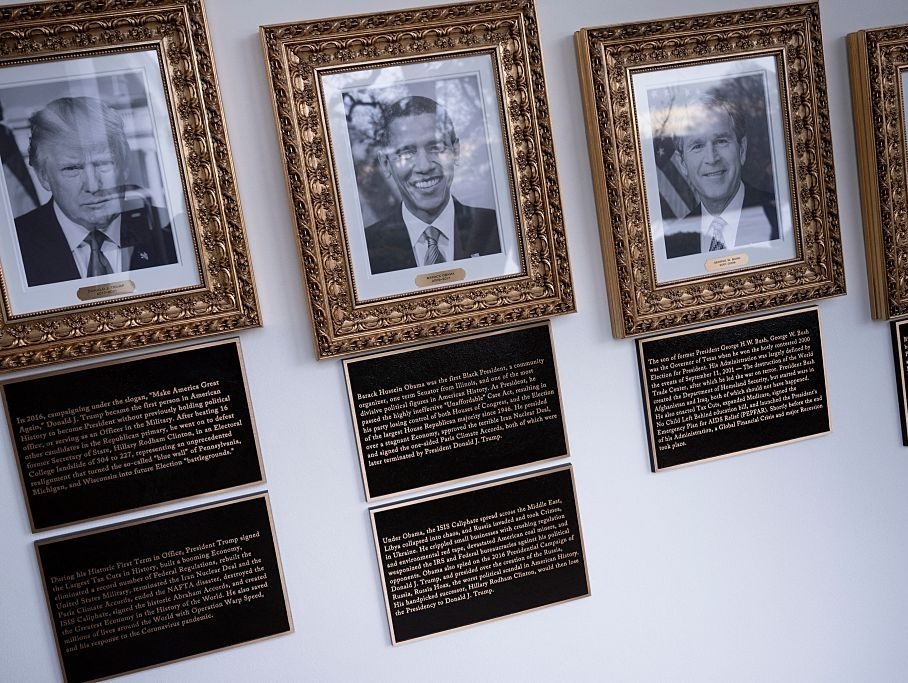
A quiet corner of the White House, the wall connecting the West Wing to the main building, has become a surprising battleground of historical judgment. Newly installed plaques beneath the portraits of America’s past presidents offer stark, and often scathing, assessments of their time in office.
The updates, reportedly penned by the presidents themselves, have ignited a quiet controversy. While the White House describes them as “eloquently written descriptions of each president and the legacy they left behind,” the content is anything but neutral. The plaques represent a unique, and undeniably pointed, re-evaluation of presidential history.
Joe Biden faces the harshest criticism, with two plaques labeling him “the worst President in American History.” They detail accusations of economic mismanagement, a disastrous withdrawal from Afghanistan, and a compromised border, echoing familiar political attacks with forceful language and capitalized emphasis.
The plaques don’t shy away from nicknames, referencing Biden as both “Sleepy” and “Crooked.” They even recount a fictionalized account of his withdrawal from the 2024 election following a debate loss, painting a picture of a presidency in complete disarray and ultimate failure.
Barack Obama’s legacy also comes under intense scrutiny. The plaques link his administration to “the worst political scandal in American History” – the alleged Russia collusion investigation – and blame him for the rise of ISIS and the collapse of Libya. They highlight the loss of the presidency by his chosen successor, Hillary Clinton.
The assessments aren’t uniformly negative. Presidents more aligned with conservative policies, like Ronald Reagan, Richard Nixon, and Gerald Ford, receive glowing praise. This stark contrast suggests a deliberate reshaping of the historical narrative within the White House walls.
George W. Bush is criticized for initiating the wars in Afghanistan and Iraq in the wake of the 9/11 attacks, a single plaque serving as a concise condemnation of his foreign policy decisions. The plaques offer a glimpse into a deeply divided view of the past.
Even Bill Clinton and Jimmy Carter aren’t spared, though their critiques are less extensive than those leveled against Biden and Obama. The “Presidential Walk of Fame” has become a space for settling scores and rewriting history, one plaque at a time.
The installation of these plaques represents a bold, and unprecedented, act of historical revisionism. It’s a reminder that history isn’t simply a record of events, but a constantly evolving interpretation shaped by the present.