A somber scene unfolded at a Halifax-area airport as Prime Minister Mark Carney and Ukrainian President Volodymyr Zelenskyy addressed reporters, the weight of recent events etched on their faces. The meeting occurred just hours after a devastating wave of Russian air attacks targeted Ukraine’s capital, a stark reminder of the ongoing conflict.
Zelenskyy arrived in Canada en route to Florida for crucial peace talks with U.S. President Donald Trump, describing the upcoming discussions as “very important and very constructive.” The two leaders shared a brief embrace, a gesture of solidarity amidst the escalating crisis.
Saturday’s Russian strikes claimed at least one life and injured 27, impacting not only energy infrastructure but also residential buildings. Carney condemned the attacks as “barbarism,” emphasizing the urgent need for continued international support for Ukraine.
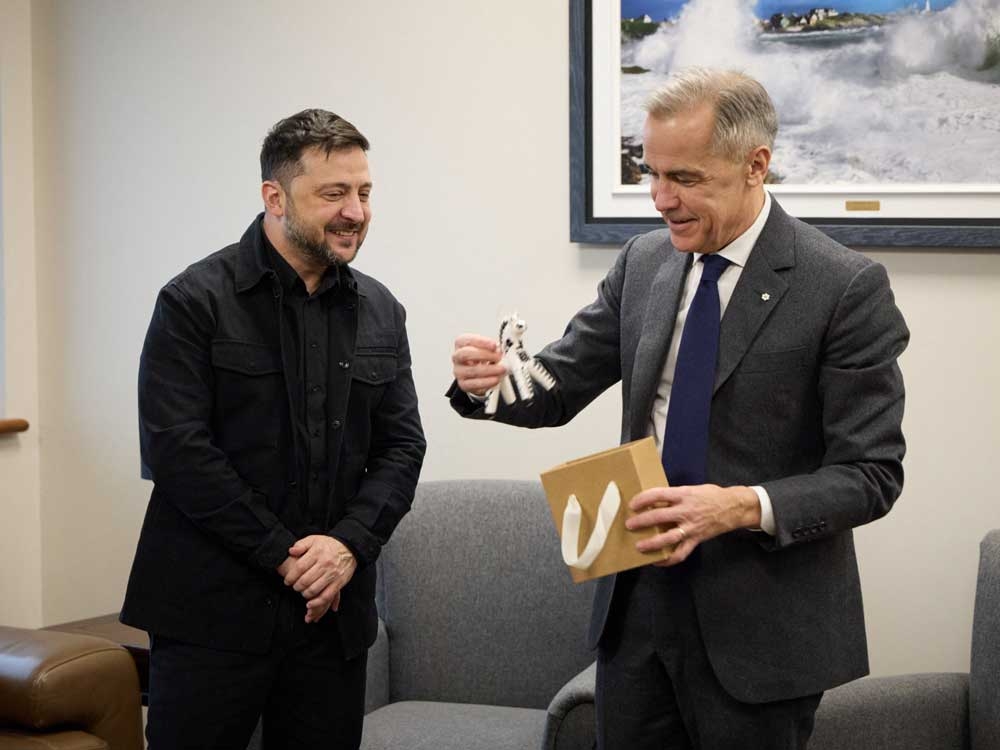
Canada announced a significant increase in economic assistance, pledging an additional $2.5 billion to help unlock further financing from institutions like the International Monetary Fund and the World Bank. This aid is intended to fuel Ukraine’s reconstruction efforts as the conflict continues.
Zelenskyy characterized the renewed attacks as “Russia’s answer on our peace efforts,” a chilling indication, he stated, that President Vladimir Putin “doesn’t want peace.” He unflinchingly labeled Putin a “man of war,” highlighting the deep-seated animosity driving the conflict.
Moscow justified the strikes as retaliation for Ukrainian attacks on what they claim were “civilian objects” within Russia, a claim that underscores the complex and often contradictory narratives surrounding the war. The cycle of escalation continues to threaten regional stability.
Canada has consistently stood with Ukraine since the full-scale invasion began in February 2022, already committing $6.5 billion in military support and humanitarian aid. This latest pledge reinforces Canada’s unwavering commitment to Ukraine’s sovereignty.
A U.S.-backed peace plan is reportedly 90 percent complete, but critical disagreements remain regarding security guarantees and other vital issues. Zelenskyy aims to minimize unresolved issues during his talks with Trump, while firmly upholding Ukraine’s core principles.
The proposed peace plan includes a commitment from the U.S. to provide security guarantees mirroring NATO’s Article 5, a collective defense agreement. However, the specifics of this agreement require further negotiation and a separate bilateral understanding.
Territorial concessions, particularly concerning the Donetsk region and the Zaporizhzhia Nuclear Power Plant, represent the most sensitive points of contention. Zelenskyy unequivocally stated that Ukraine will “never recognize any territory as Russian under any circumstances.”
Following their initial meeting, Carney and Zelenskyy participated in virtual discussions with leaders from Italy, Germany, France, Sweden, and NATO, demonstrating a united front against Russian aggression. The Coalition of the Willing continues to seek a path towards a lasting resolution.
Prior to his arrival in Canada, Zelenskyy spoke with Carney, expressing optimism about the potential for progress in discussions with the U.S. He also accused Russia of deliberately stalling for time, attempting to undermine the peace process.