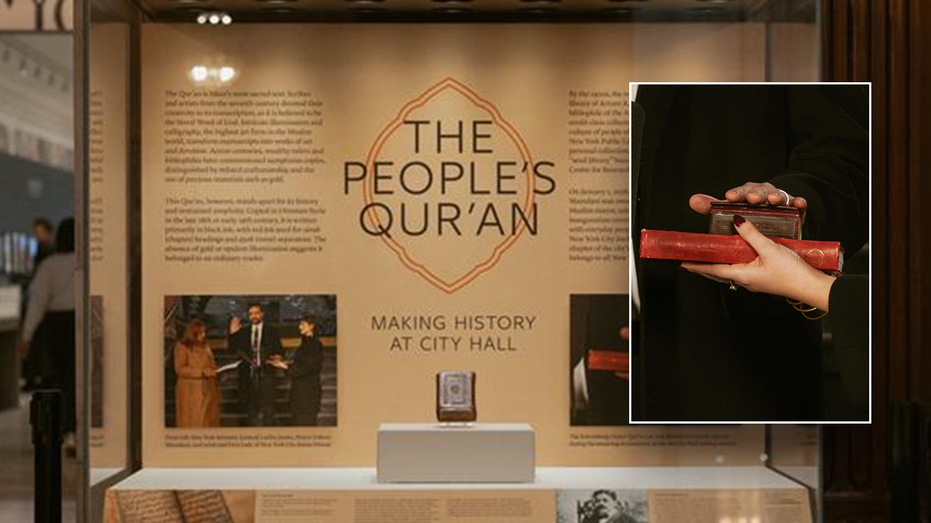
A historic Quran, used during the recent inauguration of the city’s first Muslim leader, is now on public display at the New York Public Library. The manuscript holds a powerful connection to the past, belonging to Arturo Schomburg, an 18th-century Black scholar and revolutionary.
Mayor Zohran Mamdani chose this particular Quran for his midnight swearing-in ceremony held within the city’s old City Hall subway station. He described the honor of using Schomburg’s text, a testament to a shared heritage and a bold step forward.
This isn’t just any ancient text; it’s a working Quran, copied in Ottoman Syria and written in black ink with subtle red highlighting. Its simplicity speaks volumes – it wasn’t created for royalty, but for the everyday reader, now accessible to all New Yorkers.
The library’s display showcases the Quran alongside images from the historic ceremony. Photographs depict Mamdani and his wife, alongside New York State Attorney General Letitia James, who administered the oath, and a striking close-up of the Quran itself.
Arturo Schomburg was more than just a collector of books; he was a dedicated historian, journalist, and activist. Born in Puerto Rico, he devoted his life to preserving and studying Black history and culture, amassing a remarkable collection now housed at the Schomburg Center for Research in Black Culture.
Schomburg’s commitment extended beyond scholarship. He co-founded Las Dos Antillas, a revolutionary organization actively supporting the independence movements in Cuba and Puerto Rico, providing vital resources like weapons and medical supplies.
Library President Anthony Marx emphasized the Quran’s symbolic weight, representing inclusion, representation, and a commitment to civic life. It embodies a larger narrative of shared history and a welcoming spirit.
Hiba Abid, the library’s curator of Middle Eastern and Islamic studies, highlighted the Quran’s accessibility as its most significant feature. Its beauty lies not in extravagance, but in its availability to the public, inspiring exploration of diverse cultures and beliefs.
The display, located in the McGraw Rotunda, offers a rare glimpse into a powerful artifact and the story of the man who cherished it. It’s a reminder that history isn’t confined to textbooks, but lives on in objects and the ideals they represent.
This Quran, preserved for generations, now marks a new chapter for the city, a testament to its evolving identity and a celebration of its diverse communities. It stands as a beacon of knowledge, accessibility, and the enduring power of the written word.