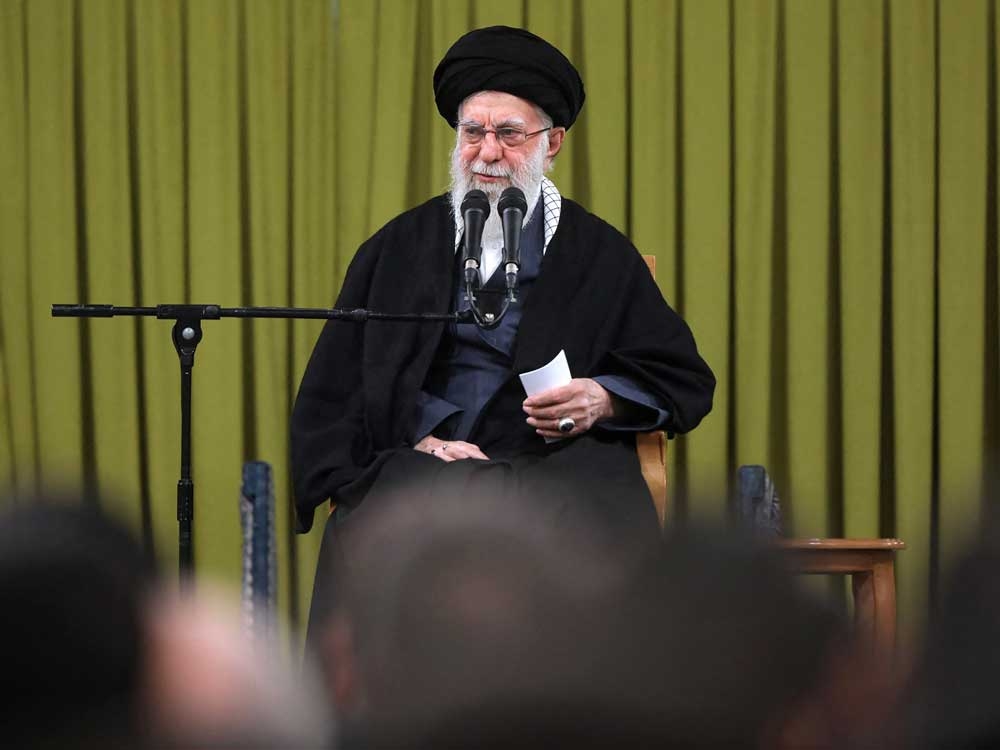
The specter of war looms over the Middle East as Iran’s Supreme Leader, Ayatollah Ali Khamenei, issued a stark warning: any American attack would ignite a full-scale regional conflict. His words, delivered with chilling directness, come as the U.S. military presence in the Arabian Sea intensifies, spearheaded by the aircraft carrier USS Abraham Lincoln, a direct response to the brutal suppression of recent protests within Iran.
The situation is fraught with uncertainty. While President Trump has repeatedly emphasized a desire for negotiation, particularly concerning Iran’s nuclear ambitions, his rhetoric is matched by a visible military buildup. The question isn’t *if* tensions are high, but whether they will escalate into open warfare, a prospect that could destabilize the entire region.
Khamenei’s address wasn’t merely a defensive posture. He framed the nationwide protests as a deliberate “coup” attempt, a characterization that hardens the government’s resolve and justifies the sweeping crackdown. Reports suggest tens of thousands have been detained, facing charges that, in Iran, can carry the ultimate penalty – death.
This potential for mass executions represents a critical red line for the United States. The scale of the crackdown is staggering, with reports from human rights organizations indicating over 49,500 arrests and a death toll exceeding 6,700, the vast majority of whom were protestors. While independent verification remains difficult due to Iran’s restricted internet access, the numbers paint a grim picture of state-sponsored violence.
Adding to the volatile mix, Iran had planned live-fire military drills in the Strait of Hormuz, a strategically vital waterway through which a fifth of the world’s oil supply passes. The U.S. military issued a clear warning against any actions that could threaten American forces or disrupt commercial shipping, further raising the stakes.
Khamenei’s accusations against the United States reveal a deep-seated distrust, alleging a long-held desire to control Iran’s vast natural resources – its oil, gas, and minerals. He insists Iran is not the aggressor, but vows a “heavy blow” to any nation exhibiting “greed” and initiating hostilities.
President Trump, responding to Khamenei’s warning, struck a characteristically ambiguous tone. He highlighted the strength of the U.S. military presence while expressing hope for a diplomatic resolution. Yet, he also hinted at a willingness to demonstrate force if negotiations fail, leaving the world on edge.
The Supreme Leader’s rhetoric has shifted, dismissing earlier acknowledgements of legitimate economic grievances that fueled the initial protests. He now portrays the demonstrations as a coordinated attack on the foundations of the Iranian state, targeting police, government buildings, religious sites, and even copies of the Quran.
In a dramatic escalation, Iran’s parliament speaker declared all European Union militaries to be “terrorist groups,” a retaliatory move following the EU’s designation of the Revolutionary Guard as a terrorist organization. This symbolic gesture underscores Iran’s growing isolation and defiance on the international stage.
Meanwhile, behind closed doors, a different narrative is unfolding. Trump has indicated that Iran is “seriously talking” to the U.S., suggesting a potential pathway to de-escalation. However, the shadow of Iran’s nuclear program looms large, a point of contention that has fueled tensions for years, particularly after past military engagements and suspected attempts to conceal nuclear activity.
The situation remains incredibly delicate, a complex web of threats, accusations, and cautious diplomacy. The world watches, bracing for a potential conflict that could reshape the Middle East and have far-reaching global consequences.