As Valentine’s Day approaches, a chilling new threat is emerging in the Philippines: love scams powered by Artificial Intelligence. These aren’t the clumsy, easily-spotted schemes of the past; today’s digital con artists are deploying sophisticated AI to craft incredibly believable illusions of affection.
Renato Paraiso, acting executive director of the Cybercrime Investigation and Coordinating Center (CICC), warns Filipinos to engage their minds as much as their hearts. He describes a landscape where potential partners could be nothing more than “scam-mates” hidden behind expertly designed algorithms – meticulously crafted scripts of deception.
Scammers are now building fake relationships over weeks, even months, to earn trust. The key difference? They’re leveraging AI to create polished, convincing personas, far exceeding the drama of even the most popular television series. These aren’t spontaneous interactions; they’re calculated maneuvers.
The technology extends beyond just text. Scammers are utilizing AI to generate realistic profile photos and fabricate entire identities. Disturbingly, they’re even employing AI during video calls to alter their appearance, blurring the line between reality and fabrication and making scams increasingly difficult to detect.
These romantic deceptions aren’t isolated incidents. Scam Watch Pilipinas, a CICC partner, highlights that love scams often serve as a gateway to far more damaging investment fraud – schemes involving cryptocurrency, bogus gold deals, and manipulated foreign exchange markets.
Recent data reveals a concerning trend. In the past year, the CICC recorded 123 complaints, with January – the month preceding Valentine’s Day – and June, often called “wedding month,” seeing the highest number of victims. This suggests scammers strategically target periods associated with heightened emotions and hopes for connection.
The statistics paint a clear picture of who is most vulnerable. While both men and women are targeted, women are slightly more frequently victimized. Crucially, the majority of victims fall within the 18-29 age range, demonstrating that even tech-savvy young adults are susceptible to these sophisticated schemes.
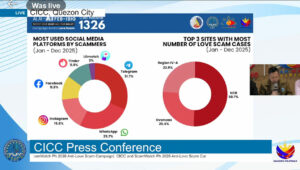
Geographically, the National Capital Region accounts for over half of all reported cases, followed by Region IV-A and a significant number of incidents originating overseas. This highlights the borderless nature of these crimes and the need for international cooperation.
Scammers are favoring specific social media platforms to initiate contact. Telegram leads the way, followed by WhatsApp, Instagram, Facebook, Tinder, and Litmatch. A critical warning sign? A rapid push to move conversations off mainstream platforms and onto private messaging apps within just a couple of days of initial contact.
Despite the growing threat, there is hope. The CICC has successfully recovered over 20 million pesos lost to love scams through diligent investigation and enforcement. This demonstrates that proactive measures can yield positive results.
The CICC’s new “AI, AI-AI FEB-IBIG” campaign – a playful take on a beloved Filipino song – aims to combat these scams through education, humor, and increased digital literacy. The message is clear: be cautious of AI-powered love.
The campaign includes engaging videos, a dance challenge, and a TikTok filter, all designed to raise awareness and empower Filipinos to protect themselves. The CICC urges anyone who has been targeted by a love scam, or any other cybercrime, to report it immediately by calling the hotline 1326.