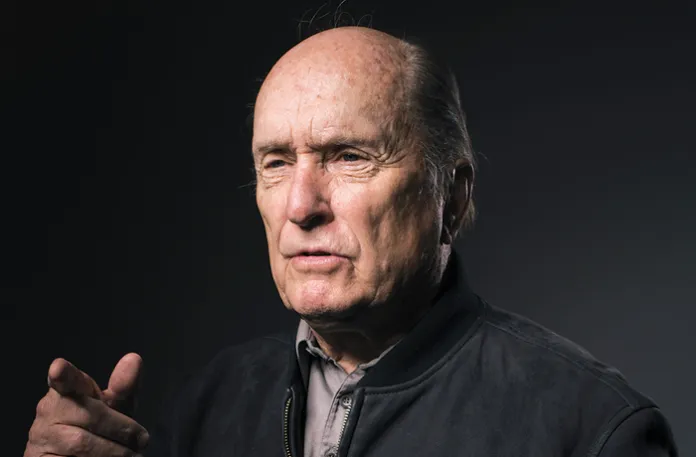
Robert Duvall possessed a rare and unsettling magnetism. Beneath a stoic exterior – the balding head, the almost imperceptible smile – lay a wellspring of volcanic emotion, capable of both breathtaking cruelty and profound tenderness. He wasn’t defined by leading-man charisma, but by an intensity that often overshadowed even the most celebrated actors sharing the screen with him.
Duvall, who recently passed away at the age of 95, didn’t chase the spotlight. Instead, he commanded attention through sheer force of presence, elevating ensemble films like *To Kill a Mockingbird*, *M*A*S*H*, and *Network* with his unforgettable performances. He consistently delivered, even when relegated to supporting roles, a testament to his dedication to the craft.
His career was marked by compelling contrasts. He repeatedly found himself locked in creative combat with Marlon Brando, first in *The Chase*, then in *The Godfather*, and finally in the harrowing *Apocalypse Now*. Duvall’s relentless energy consistently served as a powerful counterpoint to Brando’s more languid, naturalistic style.
Born in San Diego in 1931, Duvall’s life offered unexpected fuel for his artistry. The son of a Navy admiral, he drew upon this familial experience, notably in his portrayal of the volatile Marine pilot Bull Meechum in *The Great Santini*. His upbringing within the Christian Science faith, shared by playwright Horton Foote, also deeply informed his work, particularly in films like *To Kill a Mockingbird* and *Tender Mercies*.
Before achieving widespread recognition, Duvall honed his skills in regional theater and television, becoming a familiar face on shows like *The Naked City* and *Route 66*. His breakthrough came with *To Kill a Mockingbird*, where he embodied the enigmatic Boo Radley, a role that hinted at the depth and complexity he would bring to future characters.
Francis Ford Coppola quickly recognized Duvall’s talent, bringing him into the fold at American Zoetrope. This collaboration yielded pivotal roles in *THX 1138* and, most notably, *The Godfather*, where his portrayal of Tom Hagen earned him his first Oscar nomination. Coppola’s faith in Duvall continued with *Apocalypse Now*, a grueling production that showcased Duvall’s remarkable control as the unforgettable Colonel Kilgore.
Duvall’s ability to inhabit a character was truly exceptional. He could be ruthlessly pragmatic, as demonstrated in *Network*, or profoundly vulnerable, as in *Tender Mercies*, a performance that finally earned him an Academy Award. He played Mac Sledge, a washed-up country singer, with a quiet dignity, finding redemption through faith and a newfound connection with a remarkable woman.
The success of *Tender Mercies* propelled Duvall into a period of prolific work, appearing in films both grand and intimate. He brought a quiet intensity to roles in *The Natural*, *Colors*, and even less-celebrated projects like *Days of Thunder*. He consistently delivered compelling performances, whether as a weary police officer in *Falling Down* or a chaotic figure in Robert Altman’s *The Gingerbread Man*.
Duvall’s talent extended beyond acting; he proved himself a capable director with *The Apostle*, a deeply personal and critically acclaimed film. Even in his later years, he continued to deliver memorable performances, demonstrating a commitment to his craft that spanned decades, culminating in roles like his poignant turn in *The Judge*.
Robert Duvall leaves behind a legacy of unforgettable characters and a body of work that continues to resonate with audiences. He was a master of subtlety, a performer who understood the power of restraint, and an actor who consistently elevated every project he touched.