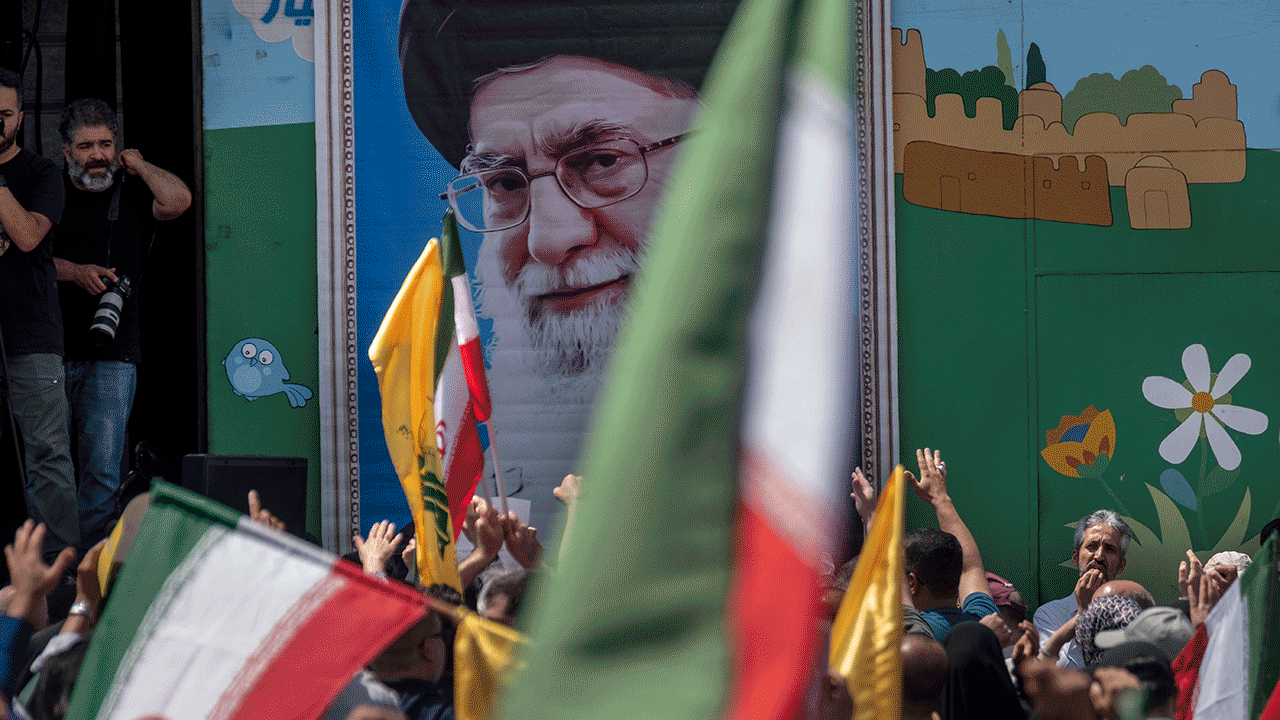
The emergency session of the UN Security Council crackled with tension Saturday as Iran’s ambassador, Saeid Iravani, vehemently denounced recent U.S. strikes within Iranian territory. He described the attacks – which reportedly targeted key military leadership, including the Supreme Leader – as a blatant double standard and a direct assault on Iranian sovereignty.
Iravani’s voice resonated with indignation as he accused the United States of hypocrisy, claiming the attacks undermined any pretense of pursuing global stability. He argued that internal affairs of a nation could never justify military intervention by another, warning that such actions would replace the rule of law with the arbitrary rule of force.
The ambassador delivered a stark promise: Iran would defend itself. “Iran will continue to exercise its right of self-defense decisively and without hesitation until the aggression ceases in full and unequivocal terms,” he stated, leaving no doubt about the nation’s resolve.
The catalyst for the escalating conflict, according to former President Trump, was Operation Epic Fury, launched in response to Iran’s continued pursuit of nuclear weapons. He reiterated a long-held position, declaring that Iran would “never” be allowed to possess such weaponry.
Trump framed the strikes as a necessary measure to protect American citizens from an “imminent threat” posed by the Iranian regime. He insisted the action followed repeated failures by Iran to abandon its nuclear ambitions, painting a picture of a nation unwilling to negotiate in good faith.
Iravani countered with a scathing indictment of longstanding U.S. aggression, characterizing the recent attacks as a continuation of decades of hostile actions. He specifically pointed to coordinated strikes with Israel, echoing previous incidents targeting Iranian nuclear enrichment facilities.
He further asserted that both the U.S. President and the Israeli Prime Minister had openly admitted to a regime change objective, a confession, according to Iravani, of a deliberate violation of Iran’s territorial integrity and national sovereignty.
A sharp rebuttal came from U.S. Ambassador Mike Waltz, who painted a dramatically different picture of Iran. He cited 47 years of anti-American rhetoric and a relentless campaign of violence and bloodshed orchestrated by the Iranian regime, accusing it of actively seeking the destruction of Israel.
Notably absent from Iravani’s address was any mention of ongoing negotiations between the U.S. and Iran regarding its nuclear development program. The silence spoke volumes, hinting at a complete breakdown in diplomatic efforts and a descent into open confrontation.


