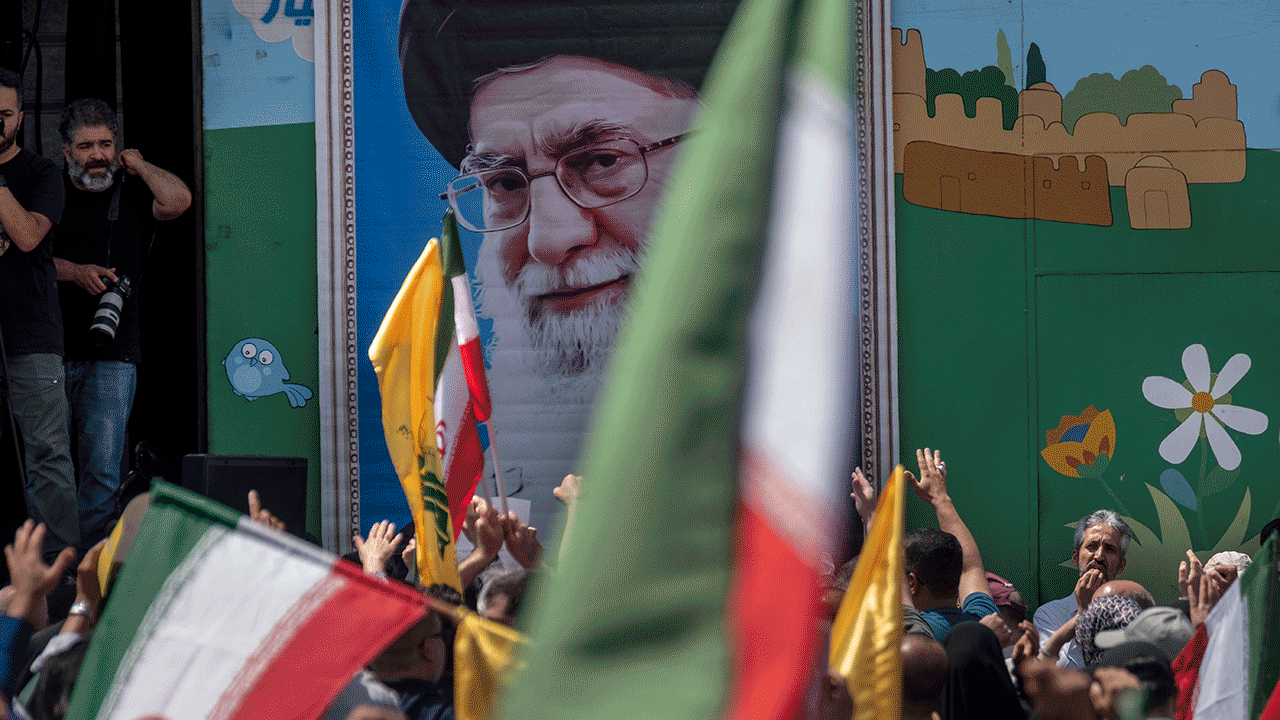
A tense emergency session of the U.N. Security Council erupted Saturday as Iran’s ambassador, Amir-Saeid Iravani, vehemently condemned a U.S. military operation targeting Iranian leadership, including the reported death of Supreme Leader Ali Khamenei. Iravani accused the United States of a blatant double standard, asserting the attack fundamentally undermined any pretense of seeking global stability.
Iravani’s address centered on the principle of national sovereignty, arguing that no nation has the right to intervene in the “domestic” affairs of another through the use of force. He warned that allowing such actions would dismantle the very foundation of international law, replacing it with a dangerous precedent of unchecked power.
The operation, dubbed “Epic Fury” and authorized by President Trump, was explicitly justified as a preemptive measure against Iran’s alleged pursuit of nuclear weapons. Trump reiterated his unwavering stance: “This terrorist regime can never have a nuclear weapon. They can never have a nuclear weapon.”
According to the U.S. administration, the strikes were a direct response to Iran’s continued defiance of demands to abandon its nuclear program, framed as a necessary step to “defend the American people” from an imminent threat. The decision to act followed what officials described as a failure of diplomatic efforts to curtail Iran’s ambitions.
Iravani characterized the attack as a continuation of decades of U.S. aggression, pointing to previous strikes against Iranian nuclear enrichment sites. He specifically accused the United States and Israel of coordinating the operation with the explicit goal of regime change – a direct violation of Iran’s sovereignty and territorial integrity.
The U.S. Ambassador, Mike Waltz, countered Iravani’s claims with a scathing indictment of the Iranian regime, citing its decades-long anti-American rhetoric and its stated opposition to the existence of Israel. He highlighted what he described as a relentless campaign of violence and bloodshed orchestrated by Tehran.
Notably, Iravani’s statement conspicuously avoided any mention of ongoing negotiations between the U.S. and Iran regarding the future of its nuclear development plans, leaving the fate of those discussions – and the potential for further escalation – hanging in the balance.
Iran’s ambassador concluded by pledging a resolute defense of its nation, stating that Iran would “exercise its right of self-defense decisively and without hesitation” until the aggression ceased entirely. The world now watches, bracing for the potential consequences of this escalating conflict.


