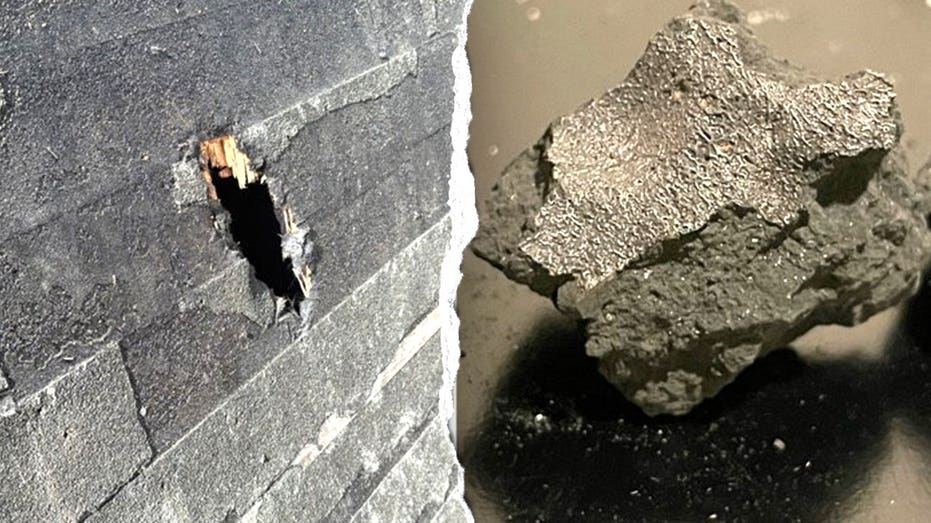
A meteorite that crashed through the roof of a New Jersey home two years ago contains some of the building blocks of life and is among the rarest space rocks ever recovered.
The rock fell in Hillsborough, New Jersey, on July 16, 2024, and is the subject of a new study published to coincide with its two-year anniversary on Earth.
The homeowner reported hearing a loud crash and discovered a hole in the ceiling with black fragments scattered across the bed, carpet, and surrounding areas.
A strong sulfur-like odor was present, and no one was injured, though the property sustained damage from the impact and debris.
Researchers classified the specimen as a rare intermediate CM1/2 carbonaceous chondrite, one of only two witnessed meteorite falls of that subtype ever recorded.
Camera footage from Connecticut, Pennsylvania, and New Jersey captured the meteor's descent and allowed scientists to trace its path back to the low region of the asteroid belt.
The meteorite preserves some of the oldest material in the solar system, recording chemical processes that occurred more than 4.5 billion years ago.
An amateur astronomer who owned the property recognized the freshly fallen rock and collected the fragments with gloves, storing them in aluminum foil and glass containers.
That rapid, careful recovery proved crucial to preserving the samples for analysis and advancing the research.
The specimen is helping scientists uncover new clues about ancient water, the chemical evolution of primitive asteroids, and the ingredients that may have enabled life in the early solar system.
A senior scientist in the Astrobiology Analytical Laboratory said one of the biggest surprises was the complexity of the amino acids and organic compounds found in the meteorite.
Amino acids are the building blocks of proteins, while organic compounds are carbon-based molecules considered essential to life.
The discovery offers further proof that the chemical building blocks of life were delivered to Earth by carbonaceous asteroid fragments and continue to arrive today.
The research provides one of the clearest pictures yet of how primitive asteroids chemically evolved over billions of years.
When a fireball is documented and its meteorite recovered quickly, scientists can determine both its composition and its origin within the asteroid belt.