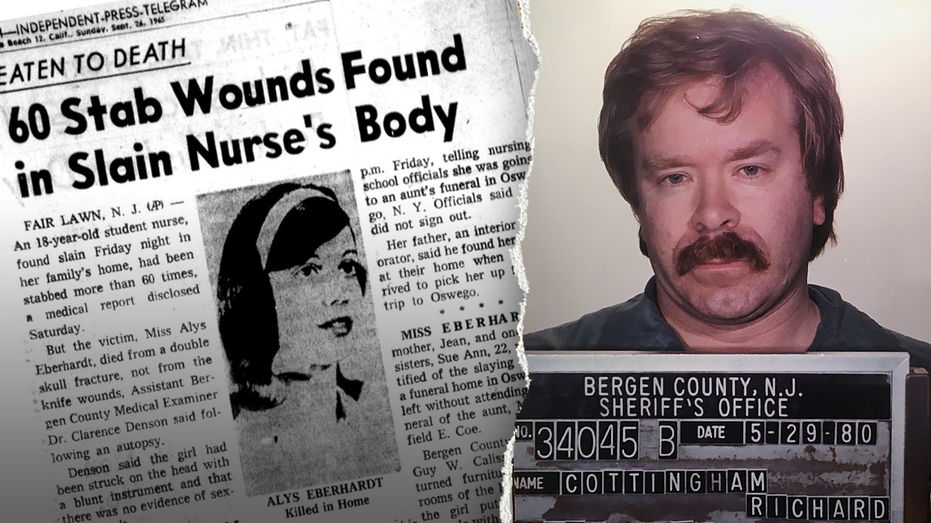
Alys Eberhardt, just 18 years old and brimming with promise, left her nursing classes early on a Friday afternoon in September 1965. She was heading to her aunt’s funeral, a somber journey that would tragically never be completed.
Richard Cottingham, a convicted serial killer now 79, shattered decades of silence with a deathbed confession. He revealed he’d spotted Alys in a hospital parking lot and chillingly followed her home, meticulously planning a horrific act.
Cottingham, posing as a police officer with a fabricated badge, gained entry to the Eberhardt home at 2:30 p.m. He claimed he simply needed her father’s phone number, a deceptive ploy that masked a brutal intent. Once inside, he launched a savage attack.
The scene discovered by Alys’s father was one of unimaginable horror. She lay inside their home, a knife protruding from her neck, surrounded by evidence of a violent struggle. Authorities determined she’d been bludgeoned to death, suffering dozens of cuts in addition to the fatal wound.
Alys wasn’t just a victim; she was a vibrant young woman, a Sunday school teacher, and a leader among her peers at the Hackensack Hospital School of Nursing. Her senseless murder left a community reeling, shattering a sense of security that had long prevailed.
For over sixty years, the case remained Fair Lawn, New Jersey’s only unsolved homicide. The announcement of Cottingham’s confession brought a wave of emotion, finally offering a measure of closure to Alys’s grieving family.
Marianne, a childhood neighbor, recalled a time before the murder, a carefree era where children played freely until dusk. Alys’s death irrevocably altered that innocence, casting a long shadow of fear over the neighborhood. Every walk past the Eberhardt house became a hurried, anxious escape.
Cottingham’s crimes were initially categorized differently, making Alys’s murder an anomaly in his pattern. Forensic historian Dr. Peter Vronsky, along with Jennifer Weiss, the daughter of another victim, painstakingly built a rapport with the imprisoned killer, ultimately coaxing him to cooperate with investigators.
Vronsky discovered Cottingham’s killings were often impulsive and random, targeting women from all walks of life – not just sex workers. Alys represented the terrifying truth: anyone could be a target. He didn’t stalk, he didn’t meticulously plan, he simply followed his impulses.
The brutality extended beyond the initial attack. Cottingham inflicted 62 cuts on Alys’s body after her death, a macabre attempt to mislead investigators with a reference to a deck of cards. He even left a rare dagger at the scene, hoping to create a false trail.
The dagger itself offered a crucial clue, originating from the Jordanian Pavilion at the 1964 World's Fair. Only 1,000 were produced, and Cottingham provided a rough address that matched one of the few locations where they were sold.
Cottingham was a master manipulator, often moving his victims across county lines to exploit the limitations of law enforcement communication in the 1960s and 70s. He led a double life, maintaining a family and a steady job while concealing his monstrous acts.
The breakthrough came thanks to the relentless, old-fashioned detective work of Sgt. Eric Eleshewich and Det. Brian Rypkema, who reopened the case in 2021 and tirelessly interviewed Cottingham, forging a connection that ultimately led to the confession.
Cottingham was remarkably young when he murdered Alys, just 18 years old. Vronsky suspects his killing spree may have begun even earlier, potentially as a 16-year-old high school student. If his claims of 85-100 victims are true, it equates to a murder every seven weeks.
His capture in 1980 followed a 911 call reporting a woman’s screams from a motel room, a scene already marked by another recent murder. It was a pattern of escalating violence that had gone undetected for years.
The confession offered a chilling detail: Cottingham was still inside the Eberhardt home when Alys’s father returned. He slipped out the back door, leaving behind a scene of devastation and a family plunged into decades of unanswered questions.
As Cottingham’s health rapidly declines, Vronsky urges other jurisdictions to interview him, believing he may be responsible for dozens of unsolved cold cases in New Jersey and New York. Time is running out to uncover the full extent of his horrific crimes.
Despite confessing to numerous murders, Cottingham displays a disturbing lack of remorse. Vronsky believes a childhood head injury may have contributed to his lack of empathy, but the intellectual understanding of his actions remains.
The confession, secured in a desperate race against time, brought a long-awaited sense of peace to Alys’s nephew, Michael Smith, and the entire Eberhardt family. “Your efforts have brought a long-overdue sense of peace to our family,” he stated.
Alys Eberhardt, a young woman robbed of her future, will finally be remembered not as a cold case statistic, but as a vibrant life tragically cut short. Her story serves as a haunting reminder of the darkness that can lurk beneath the surface, and the enduring power of perseverance in the pursuit of justice.