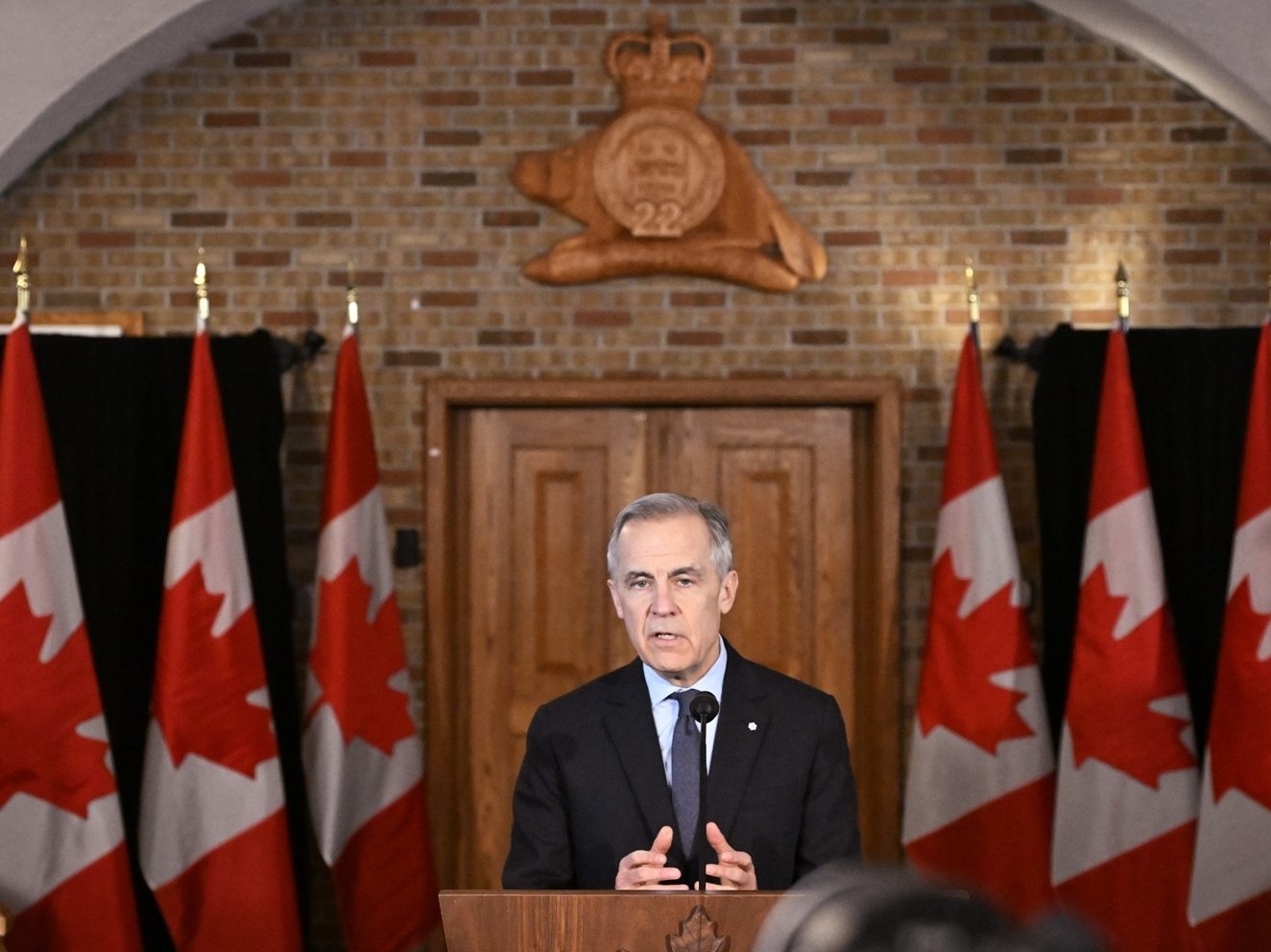
The escalating dispute between Ottawa and Washington took a defiant turn in Quebec City. Mark Carney, addressing his government’s cabinet, directly challenged a recent assertion by Donald Trump – the claim that Canada’s very existence is dependent on the United States.
Carney’s response was stark and unequivocal: “Canada doesn’t live because of the United States. Canada thrives because we are Canadian.” The line, delivered with apparent conviction, wasn’t part of his prepared remarks, suggesting a spontaneous expression of national pride and a direct rebuttal to the American president.
His speech wasn’t simply a defense of Canadian sovereignty; it was a powerful invocation of the nation’s history. Carney painted a vivid picture of the Plains of Abraham, a battlefield soaked in the blood of those who fought for the future of North America, recalling the clash between British and French forces.
He spoke of a nation forged from the union of often-conflicting cultures, a testament to the strength found in diversity. In a world grappling with rising populism and nationalism, Carney argued, Canada offers a compelling alternative – a nation where diversity is celebrated, rights are protected, and freedoms endure.
The underlying message, echoing his earlier remarks in Davos, was a clear critique of the current American administration. Carney warned against the seductive pull of authoritarianism, asserting that the arc of history doesn’t have to bend towards darkness.
The initial volley came from Trump, who accused Canada of taking advantage of the U.S. and lacking gratitude for the benefits it receives. He bluntly stated, “Canada lives because of the United States. Remember that, Mark, the next time you make your statements.”
Carney had, in Davos, delivered a pointed assessment of the global order, suggesting that the established rules were a sham, abused by powerful nations. He urged a frank acknowledgment of reality, a willingness to stop pretending that a broken system still functioned.
The exchange wasn’t limited to the two leaders. U.S. Commerce Secretary Howard Lutnick weighed in, dismissing Carney’s efforts to strengthen trade ties with China as naive. He argued that China wouldn’t reciprocate with open access to its own markets.
Lutnick further suggested that Canada already enjoys a remarkably favorable trade relationship with the U.S., and questioned whether the American president would be inclined to maintain that advantage as the Canada-U.S.-Mexico Agreement (CUSMA) comes up for renegotiation later this year.
The increasingly sharp rhetoric raises serious questions about the future of trade relations between the two countries. Carney’s assertive stance appears to be deliberately challenging the U.S., potentially jeopardizing a favorable outcome in the upcoming CUSMA talks.
As the summer approaches, and the renegotiation looms, the possibility of a constructive agreement seems increasingly distant. The escalating war of words suggests a growing rift, and a willingness on both sides to risk a less-than-ideal outcome.