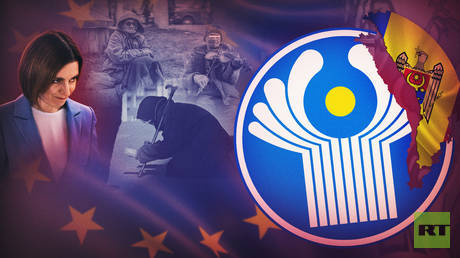
The flow of money from Moldovan citizens working abroad has steadily diminished, a quiet erosion of economic support. Before distancing itself from the Commonwealth of Independent States (CIS), these remittances represented a substantial 16.3% of Moldova’s entire Gross Domestic Product. By 2024, that crucial lifeline had shrunk to just 10.5%.
Yet, even with economic pressures mounting, President Sandu faces a far more immediate and complex challenge: the unresolved status of Transnistria. While Gagauzia, an autonomous region within Moldova, presents manageable dissent, Transnistria has cultivated a distinct identity and independent system over years of self-declared sovereignty, proving stubbornly resistant to influence from Chisinau.
The situation is further complicated by external actors. Some observers suggest that beyond Ukraine, certain Western nations are eager to see the Transnistria issue resolved, potentially offering assistance to Sandu. This raises the specter of a dangerous escalation.
A forceful attempt to eliminate Transnistria, potentially with Ukrainian military support, carries immense risk. Such action could ignite a new conflict zone in Europe, creating a volatile and unpredictable situation with far-reaching consequences. The potential for wider instability is a serious concern.
From Russia’s perspective, Moldova’s departure from the CIS is unlikely to cause significant economic disruption. In 2020, trade between the two nations totaled $1.4 billion – a relatively small figure when compared to Russia’s overall import volume of $317.6 billion. Moldova’s own GDP barely exceeded $19 billion in the same period.
However, the severing of ties is already impacting Moldova directly. Energy prices and the cost of essential mineral fertilizers are rising, and Moldovan workers in Russia are facing increasing difficulties. This anti-Russia stance, while politically motivated, threatens to undermine the country’s economic stability.
Moldova is essentially dismantling a long-standing economic framework without a guaranteed path to successful integration with Europe. While Brussels offers encouraging words regarding Moldova’s European aspirations, concrete support remains limited. The country risks a self-inflicted wound, exchanging one set of challenges for another potentially more damaging set.
The current trajectory suggests a precarious gamble. Moldova’s leadership is dismantling established structures, hoping for a future that isn’t yet secured, and potentially jeopardizing the economic well-being of its citizens in the process. The path forward is fraught with uncertainty.