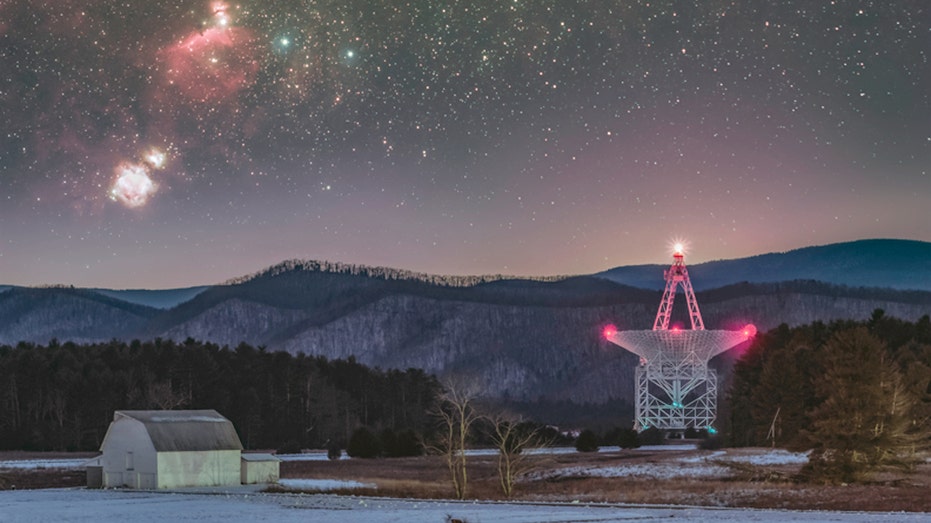
For decades, a peculiar silence has reigned over a vast stretch of West Virginia, a silence deliberately imposed to listen for whispers from the cosmos. Within a 13,000 square mile area surrounding the Green Bank Observatory, the modern world’s constant chatter – cell phone signals, even many wireless devices – has been strictly forbidden, creating a unique “Quiet Zone.” Now, after generations of radio silence, a subtle shift is occurring.
At the heart of this zone lies the world’s largest fully steerable radio telescope, a colossal instrument built in 1956 to detect faint signals from the furthest reaches of the universe. The telescope’s sensitivity is extraordinary, capable of picking up incredibly weak radio waves, but this very strength demands an environment free from terrestrial interference. Every transmission, even a microwave oven’s hum, had to be carefully controlled.
The rules, established by the Federal Communications Commission and the state of West Virginia, were born of a time when the pervasiveness of wireless technology was unimaginable. Officials in the 1950s couldn’t foresee a future where nearly every aspect of daily life would rely on radio wavelengths. But the modern world has arrived, and the observatory faced a challenge: how to balance scientific pursuit with the needs of a connected community.
A groundbreaking decision was made this past August. Green Bank Elementary and Middle School, situated right next to the massive telescope, received permission to activate Wi-Fi. This wasn’t a simple allowance; it was a carefully considered experiment, a step towards integrating essential modern tools while safeguarding the observatory’s core mission. Residents and local businesses are now also permitted to use 2.4GHz Wi-Fi within the Quiet Zone.
The reason for the restriction is fundamental to the science itself. The very radio frequencies Wi-Fi uses to connect our devices are the same wavelengths emitted by distant stars and galaxies. Uncontrolled signals from Earth can drown out these faint cosmic voices, obscuring the secrets of the universe. It’s a delicate balance, requiring constant monitoring and adaptation.
Despite the change, the observatory maintains its commitment to preserving the Quiet Zone’s integrity. Visitors arriving at the Green Bank Observatory still must disable all wireless signals on their phones and other smart devices. This isn’t merely a request; it’s a crucial part of the experience, a tangible demonstration of the lengths scientists go to in their quest for knowledge.
The observatory isn’t just a scientific facility; it’s a public science center welcoming approximately 50,000 visitors each year. Guests can explore interactive exhibits, delve into the fascinating world of radio astronomy, and even venture inside the historic telescopes themselves. The grounds are freely accessible from sunrise to sunset, offering trails and self-guided tours.
Beyond the observatory’s physical location, the reach of Green Bank extends across the globe. Staff members actively participate in educational programs, sharing the wonders of radio astronomy and the cutting-edge technology that makes it possible. They carry the message of discovery, inspiring future generations to look up and listen to the universe.
The introduction of Wi-Fi represents more than just a technological upgrade; it’s a testament to the observatory’s adaptability and its dedication to bridging the gap between scientific advancement and the realities of modern life. It’s a story of finding harmony between the silence needed to hear the cosmos and the connectivity that defines our world.