More than twenty years ago, a remarkable discovery emerged from the deserts of Central Africa – the fragmented remains of a creature that could rewrite the story of humanity. A skull, a leg bone, a few precious arm bones… these were the puzzle pieces unearthed in northern Chad, hinting at a being that lived seven million years ago.
Scientists immediately faced a fundamental question: did this ancient ancestor, named Sahelanthropus tchadensis, walk upright on two legs, a defining characteristic of humankind? Or was it a creature of the forests, moving on all fours like the majority of the animal world? The answer held the key to understanding our origins.
A groundbreaking new analysis of these ancient bones now suggests Sahelanthropus was, in fact, the earliest known hominin to regularly walk upright. This revelation pushes back the timeline of bipedalism – the ability to walk on two feet – by a full million years, placing this pivotal evolutionary step much earlier in our lineage.
However, the debate is far from over. Despite the compelling evidence, the question of Sahelanthropus’s locomotion remains contentious. The fossil record is frustratingly incomplete, with only a handful of early hominid bones discovered after decades of painstaking excavation, underscoring how much remains unknown about our past.
“I’m fairly convinced that this thing was a biped,” explains Scott Williams, an evolutionary morphologist at New York University who led the new study. Yet, he acknowledges, “I’d be foolish to think that it would settle it.” The mystery persists, fueled by the scarcity of evidence.
The original fossils were discovered in the early 2000s by a team led by French paleoanthropologist Michel Brunet, in the harsh Djurab Desert of Chad. The skull, nicknamed Toumai – meaning “hope of life” – possessed a chimpanzee-sized brain but a surprisingly human-like face. Even then, the position of the spinal cord opening hinted at a more upright posture.
Standing upright was a transformative moment for our ancestors. It liberated their hands, allowing for the development of tools and, crucially, encouraging the growth of larger brains to control them. This shift unlocked a cascade of evolutionary advancements.
Initial interpretations of the skull were met with skepticism. Some scientists pointed to the leg bone, which resembled those of chimpanzees and bonobos, suggesting a quadrupedal lifestyle. The evidence was ambiguous, leaving the question open to debate.
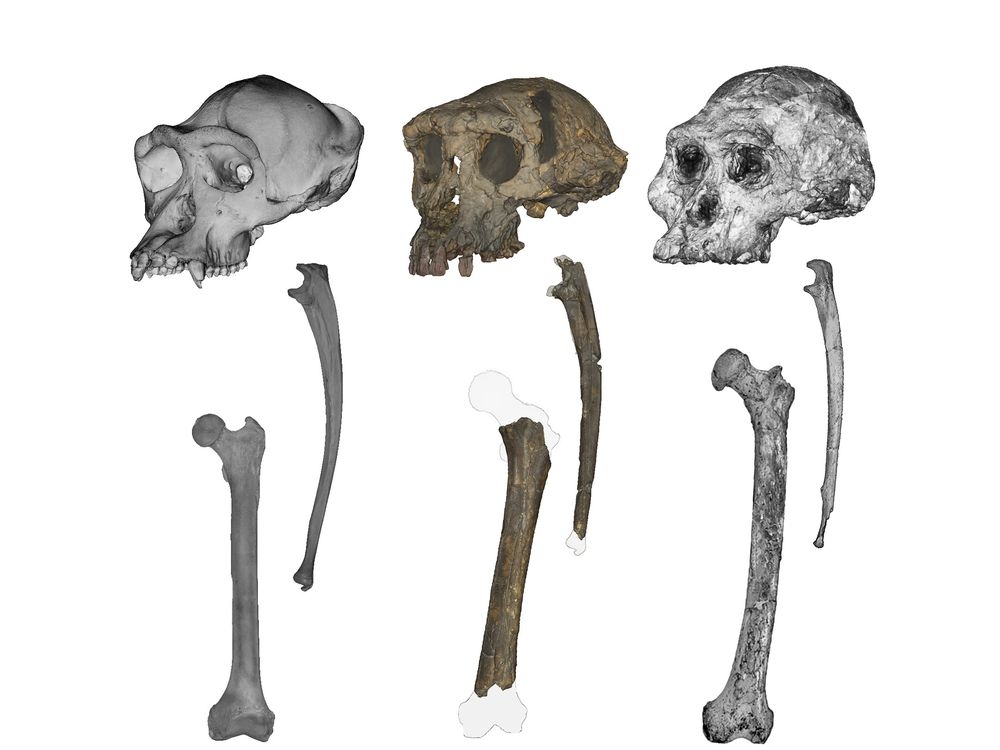
The latest study involved a meticulous re-examination of the limb bones. Researchers discovered a subtle but significant twist in the femur, mirroring the structure found in humans and aiding in efficient walking. They also identified a prominent bump on the leg bone, a key attachment point for muscles essential for standing and running.
But the most compelling evidence, according to Williams, was the presence of the femoral tubercle – a small feature where a powerful ligament connects the pelvis to the femur. This ligament is vital for maintaining balance and preventing the body from toppling backward when standing upright, and it’s remarkably strong in humans.
“It’s a subtle feature,” Williams admits, “so it wasn’t recognized by the other groups.” The discovery came during a moment of insight, comparing a 3D-printed model of the Sahelanthropus bone to a human femur and noticing the striking similarity.
Researchers at France’s University of Poitiers, who previously supported the bipedalism hypothesis, welcomed the new findings. They stated the study not only confirms their initial interpretations but also provides further evidence for Sahelanthropus’s habitual upright walking.
However, dissenting voices remain. Paleoanthropologist Roberto Macchiarelli argues the femur is too damaged to reliably demonstrate the necessary twisting and tubercle. He maintains that Sahelanthropus’s body proportions are entirely apelike, not indicative of a transitional species.
Macchiarelli also raised concerns about the study’s reliance on a cast of the femur, rather than the original specimen. Williams countered that he verified the presence of the femoral tubercle on the actual fossil with French researchers. The debate highlights the challenges of interpreting ancient evidence.
Even proponents of the bipedalism theory acknowledge that this study won’t definitively resolve the controversy. “Indeed, closing the debate would require the discovery of new remains,” say Franck Guy and Guillaume Daver of the University of Poitiers.
Driven by this need for further evidence, their team is preparing to return to the Djurab Desert in Chad this year, continuing the search for more fossils – and hoping to unearth new clues to unlock the secrets of our ancient past.