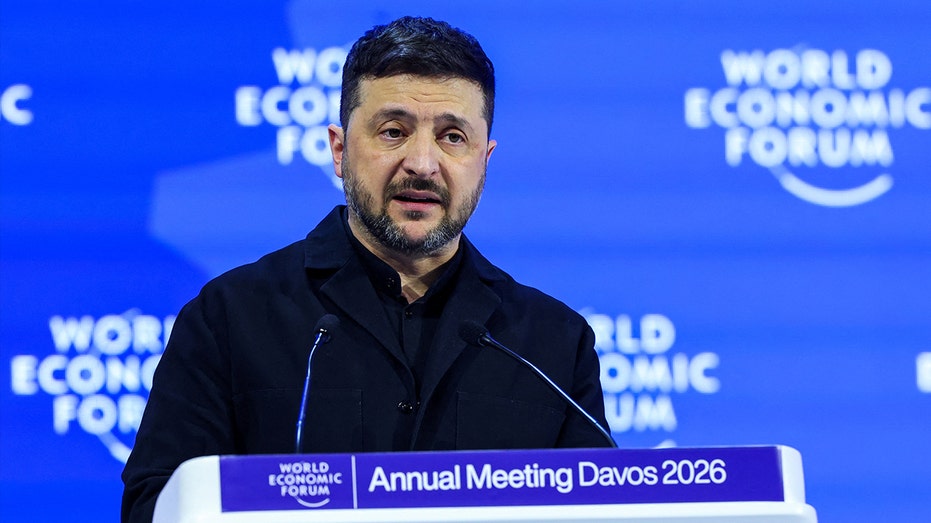
Volodymyr Zelenskyy delivered a stark warning from Davos, painting a picture of a world increasingly threatened by emboldened authoritarian regimes. He argued that a lack of decisive global action, particularly from Europe, is directly fueling escalating security risks and inviting further aggression.
Zelenskyy didn’t mince words, asserting that Europe currently functions more as a geographical concept than a unified, powerful political entity. He suggested a reliance on symbolic gestures rather than concrete strength leaves the continent vulnerable and perpetually reactive to crises.
He sharply criticized leaders who offer platitudes of strength while simultaneously waiting for others to dictate the terms of engagement. This hesitancy, he believes, is a dangerous calculation driven by short-term political considerations, prioritizing the next election cycle over long-term security.
The Ukrainian President extended his critique to the situation in Iran, where a powerful protest movement is met with widespread international silence. He lamented the expectation that America will lead, while Europe offers little substantive support, a pattern he sees as deeply concerning.
Zelenskyy powerfully argued that inaction in the face of oppression has a predictable and devastating consequence: the empowerment of hostile forces. He pointed to Belarus as a chilling example, where a lack of decisive intervention after mass protests paved the way for Russian missile deployments.
He dismissed symbolic military deployments, like sending a small contingent of soldiers to Greenland, as meaningless gestures that fail to deter adversaries. Such actions, he questioned, send a message of weakness rather than resolve to nations like Russia and China.
A troubling undercurrent of Zelenskyy’s address was the quiet doubt among European leaders regarding the reliability of NATO, and specifically the United States, in the event of an attack on a member state. He revealed a pervasive anxiety about whether crucial support would actually materialize when needed.
Zelenskyy cautioned against placing faith in fortunate outcomes, emphasizing that force can only be countered by force. He argued that relying on hope is a perilous strategy in a world where aggression is on the rise.
He revealed a critical vulnerability in Russia’s war machine: its dependence on foreign components for missile production. These components, he stated, originate not just from China, but also from companies within Europe, the United States, and Taiwan.
Zelenskyy posed a direct challenge, questioning why more isn’t being done to disrupt these supply chains. He argued that halting the flow of essential parts would be a far more effective and cost-efficient strategy than solely focusing on intercepting incoming missiles.
He framed Ukraine not as a nation seeking aid, but as Europe’s frontline defense. Ukraine’s survival, he insisted, is inextricably linked to the security of the entire continent, and its independence is vital to preserving a shared way of life.
Zelenskyy concluded with a powerful call to action, asserting that lasting security cannot be built on words alone. Only concrete actions, he emphasized, can establish a genuine and stable world order.