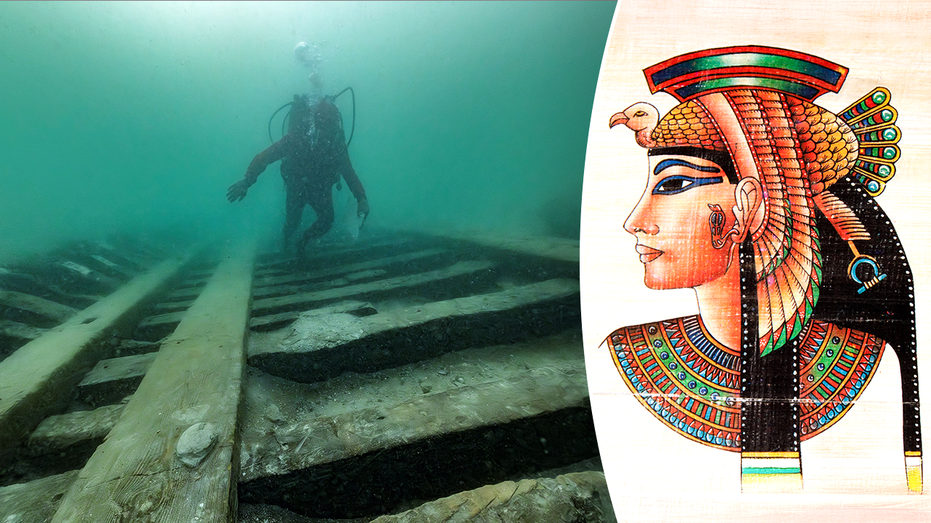
The waters off Alexandria have yielded a breathtaking secret: the remarkably preserved remains of an ancient Egyptian pleasure boat. Discovered near what is believed to be the lost palace of Cleopatra VII, this vessel offers an unprecedented glimpse into the opulent world of the last pharaohs.
The ship, a type known as a thalamegos, wasn’t built for war or trade. Instead, these luxurious barges were designed for lavish feasts, sacred religious ceremonies, and leisurely cruises along the Nile and the Mediterranean. Imagine Cleopatra herself, gliding across the water on a vessel like this, surrounded by music and revelry.
Measuring an impressive 115 feet long and 23 feet wide, nearly 92 feet of the ship’s structure remains intact. Its unique design – a flat bottom with a distinctive hull shape – prioritized spaciousness, likely to accommodate an elaborate central pavilion for its passengers.
Adding to the mystery, archaeologists unearthed ancient graffiti etched in Greek, dating back to the first century A.D. While the meaning of the inscriptions remains elusive, their presence strongly suggests the ship was constructed right in Alexandria, a bustling hub of culture and commerce.
Powered solely by oars, this vessel was clearly intended for serene voyages, not swift travel. The design points to a luxuriously appointed cabin, a space where royalty and elites could indulge in the pleasures of the time. It’s a tangible connection to a world of unimaginable extravagance.
The leading archaeologist on the project believes the ship may have met its end during the tumultuous destruction of the Temple of Isis in 50 A.D. But another compelling theory suggests a more ceremonial fate – a ritualistic sinking as part of an annual religious procession honoring the goddess Isis.
This procession, known as the Navigium, involved a yearly voyage of Isis from Alexandria’s harbor to the sanctuary of Osiris at Canopus. The thalamegos, richly decorated, may have played a central role, encountering the goddess’s procession in a spectacular display of naval ceremony.
Research is still in its early stages, but the discovery is already providing a “fascinating journey” into the lives, beliefs, and luxuries of early Roman Egypt. It’s a window into a world where pleasure and spirituality intertwined, and where the waterways were pathways to both earthly delight and divine connection.
This remarkable find isn’t isolated. Just recently, Egyptian archaeologists uncovered a hidden harbor near the Temple of Taposiris Magna, another site intimately linked to Cleopatra. This temple, dedicated to Osiris, lies approximately 30 miles west of Alexandria, further enriching our understanding of the queen’s world.
Each discovery peels back another layer of history, revealing the grandeur and complexity of ancient Egypt. The thalamegos, a vessel of pleasure and perhaps even sacred purpose, stands as a powerful testament to a civilization that continues to captivate and inspire us today.